If you love your pet but can’t stop sneezing, you’re not alone. About 10% of Americans have pet allergies, and many of them still live with cats or dogs because they refuse to give up their companions. The good news? You don’t have to choose between your health and your pet. With the right strategies, you can cut down on pet dander and breathe easier-without ever saying goodbye to your furry friend.
What Exactly Is Pet Dander?
Most people think it’s pet hair that triggers allergies. But hair is just a carrier. The real culprit is pet dander-tiny, sticky flakes of skin that cats, dogs, and even birds and rodents shed daily. These particles are so small they float in the air for hours and stick to clothes, furniture, and bedding like glue. They carry proteins that trigger allergic reactions: Fel d 1 from cats and Can f 1 from dogs. These proteins are found in saliva, skin, and urine. When pets groom themselves, they spread these allergens everywhere. Even if you don’t touch your pet, you’re still exposed.
Here’s the kicker: no breed is truly hypoallergenic. Whether it’s a poodle, a Siberian cat, or a hairless sphynx, all pets produce allergens. Some individuals may produce less, but there’s no guarantee. Studies show that even so-called “low-allergen” pets still trigger reactions in sensitive people. So don’t waste money on marketing claims-focus on what actually works.
The Bedroom Is Your Best Defense
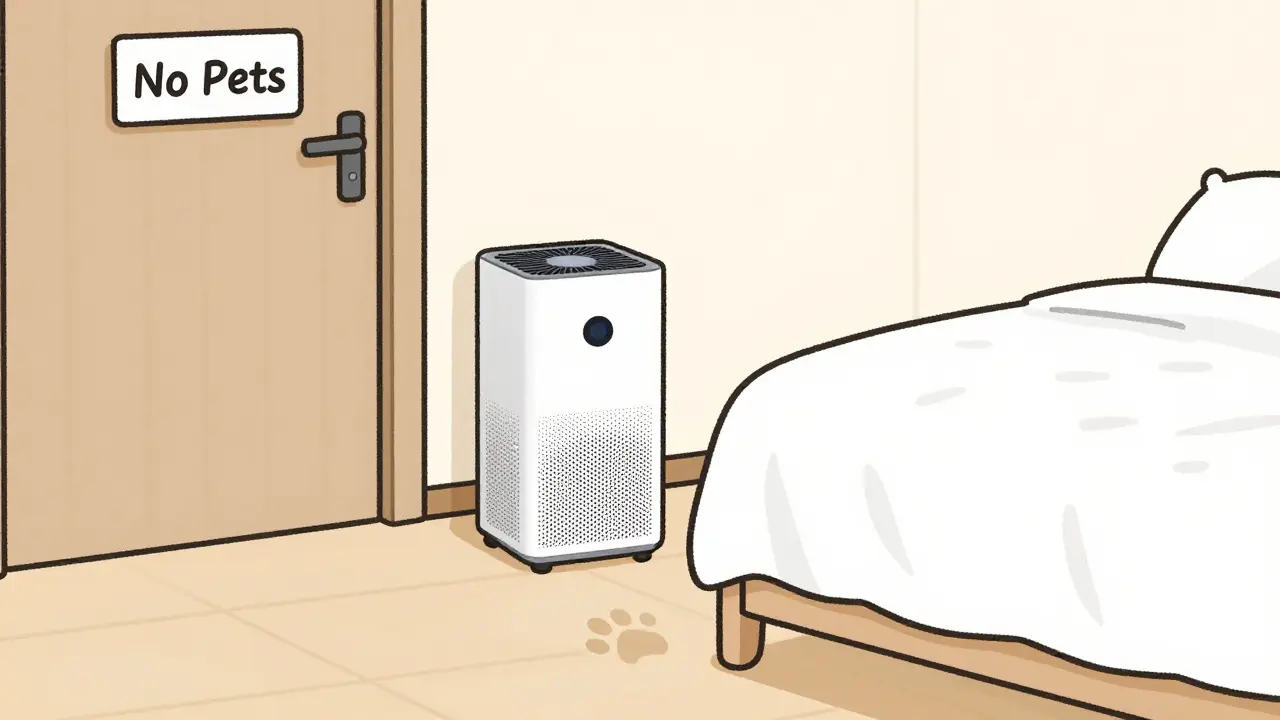
One of the most powerful moves you can make is to keep pets out of the bedroom. This isn’t just a suggestion-it’s backed by science. Research from the Cleveland Clinic found that people who banned pets from their bedrooms saw a 40% drop in nighttime allergy symptoms. Why? Because you spend a third of your life in bed. That’s where allergens accumulate in pillows, sheets, and comforters. Dust mites team up with pet dander, making things worse.
Start by removing pet beds from the room. If your dog or cat insists on sleeping with you, consider a firm boundary: no pets after 9 p.m. Use a HEPA air purifier in the bedroom-it can reduce airborne allergens by 40-60%. Pair that with washable, hypoallergenic bedding and wash sheets weekly at 130°F (54°C). That temperature kills both allergens and dust mites.
Upgrade Your Cleaning Tools
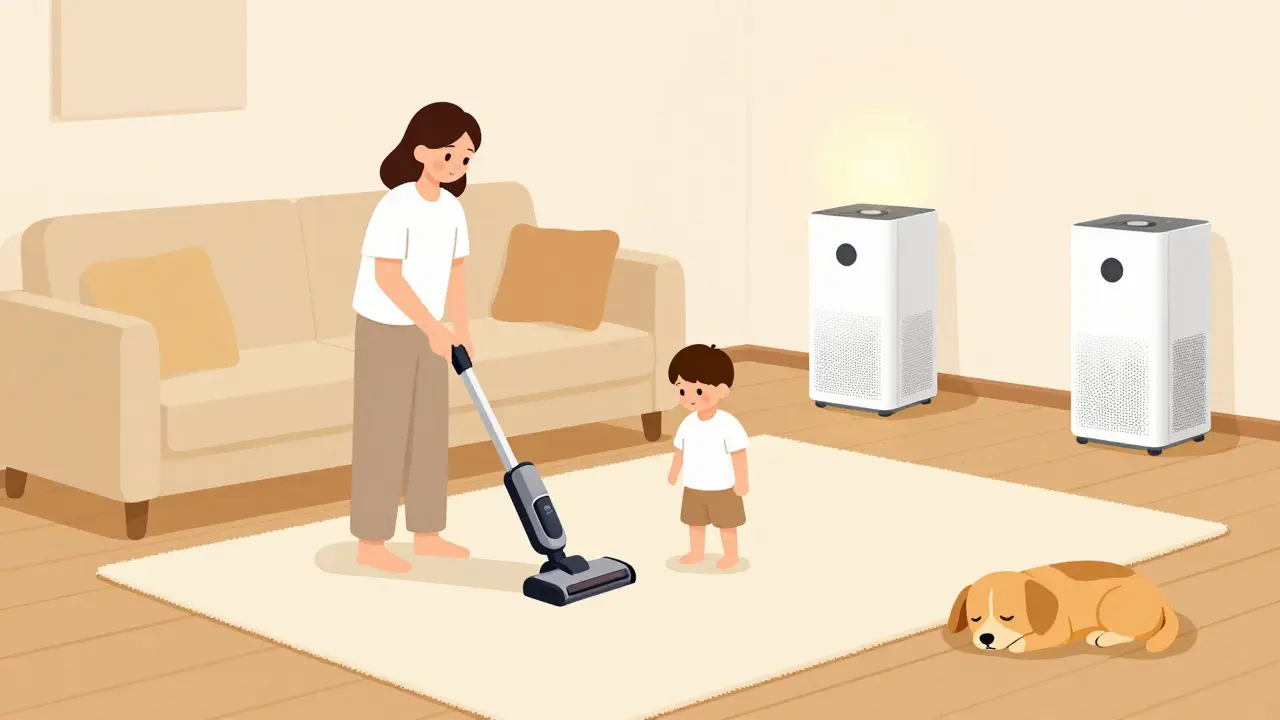
Standard vacuums don’t cut it. They blow allergens back into the air. You need a vacuum with a HEPA filter. These filters trap 99.97% of particles as small as 0.3 microns-perfect for catching dander. Filtrete’s 2023 research showed HEPA vacuums are 30-50% more effective than regular ones. Look for models labeled “sealed system,” which means no air leaks.
Vacuum at least twice a week, focusing on carpets, upholstered furniture, and under beds. If you have hardwood, tile, or linoleum floors, you’re already ahead. These surfaces hold 50-75% less dander than carpet. If replacing carpet isn’t an option, use washable rugs and clean them weekly.
Don’t forget the air purifier. Place one in your main living area. It doesn’t need to be huge-just sized for the room. True HEPA filters, not “HEPA-type,” are key. Baz Allergy’s 2023 data showed a 40-60% drop in airborne allergens when purifiers were used consistently. Replace filters every 6-12 months. It’s a small cost compared to running to the pharmacy every week.

Wash, Bathe, Wipe-Repeat
Regular pet grooming makes a huge difference. Bathing your cat or dog once a week can reduce allergen levels by up to 70%. Yes, cats hate water. Yes, dogs shake everywhere. But it’s worth it. Use a gentle, allergen-reducing shampoo-these formulas break down the proteins on the skin. Avoid human shampoos; they can dry out your pet’s skin and make shedding worse.
If weekly baths feel impossible, try wiping your pet down with a damp cloth or allergen-reducing pet wipes. Do it every few days. Focus on areas they lick most-face, paws, belly. You’ll cut down on saliva-borne allergens. Brushing outdoors also helps. Do it with a fine-tooth comb or deshedding tool. Collect the fur in a trash bag and seal it immediately.
Wash pet bedding weekly at high heat. Same rule applies: 130°F kills allergens. If your pet sleeps on the couch, cover it with a removable, washable blanket. Use lint rollers daily on clothes and furniture. They remove 70-85% of surface dander. And always wash your hands after petting your animal. That simple step cuts allergen transfer to your face by 90%.
What About Allergy Medications?
Environmental changes help-but sometimes you need backup. Over-the-counter antihistamines like cetirizine or loratadine work for about 60-70% of people with mild allergies. They kick in within an hour and can stop sneezing, itching, and runny nose. Nasal sprays with corticosteroids (like fluticasone) are even better for stuffiness and congestion.
If symptoms persist, talk to an allergist about immunotherapy. Allergy shots or sublingual tablets (like Odactra for cat allergies) train your immune system to stop overreacting. After 3-5 years of treatment, 80-85% of patients see long-term relief-even after stopping. The new sublingual tablet is a game-changer: no needles, just daily drops under the tongue. Clinical trials showed 80% symptom reduction.
Don’t wait years to get help. The American College of Allergy, Asthma, and Immunology says 40% of people delay treatment for 1-2 years, trying ineffective home remedies first. That’s not bravery-it’s unnecessary suffering.
What’s on the Horizon?
Science is catching up. Researchers at UC Davis are using CRISPR gene editing to create cats that produce 90% less Fel d 1. Early results are promising, but don’t expect these pets on shelves before 2028. Meanwhile, smart home systems are starting to appear. By 2025, you’ll be able to buy air purifiers that detect allergens in real time and adjust filtration automatically. These could cut exposure another 20-30%.
And yes, the market is growing. Pet ownership is up to 67% of U.S. households. Allergy treatments and filtration products now make up a $2.3 billion industry. That’s because more people are refusing to give up their pets-and smart solutions are rising to meet them.
Start Simple. Stay Consistent.
You don’t need to overhaul your whole house overnight. Pick one step and stick with it. Maybe it’s keeping pets out of the bedroom. Or buying a HEPA vacuum. Or washing your hands after every cuddle. Do that for two weeks. Then add another.
Studies show households that stick with 3-4 key habits-pet-free zones, HEPA vacuuming, weekly pet baths, and air purifiers-see a 50-70% drop in allergen levels within three months. And 75% of people report noticeable symptom improvement in 4-6 weeks.
It’s not about perfection. It’s about progress. You can have both a healthy home and a happy pet. You just need the right tools-and the will to use them.
Can I still have a pet if I’m allergic?
Yes. Many people with pet allergies live happily with their pets by combining environmental controls-like HEPA filters, pet-free zones, and regular cleaning-with medical treatments. No pet is truly hypoallergenic, but you can reduce allergen levels enough to manage symptoms.
Is it true that some dog breeds don’t cause allergies?
No. All dogs produce allergens, even hairless ones. The idea that certain breeds like poodles or shih tzus are hypoallergenic is a myth. Allergens come from skin, saliva, and urine-not hair length. Some individual dogs may produce less, but you can’t predict it by breed.
How long does it take to see results from dander reduction?
Most people notice less sneezing and congestion within 4-6 weeks of consistent cleaning, bathing, and using HEPA filters. It takes time for allergens to clear from carpets and furniture, so stick with it. Full results often appear after 3 months.
Do air purifiers really help with pet allergies?
Yes-if they have a true HEPA filter. Air purifiers with HEPA filters reduce airborne pet allergens by 40-60% in standard rooms. Place one in your bedroom or main living area. Avoid models labeled "HEPA-type" or "HEPA-like"-they don’t meet the real standard.
Should I bathe my pet weekly if I’m allergic?
Yes, if you can. Weekly baths reduce allergens on your pet’s skin and coat by up to 70%. Use a gentle, allergen-reducing shampoo. If your pet resists, try wipes or damp cloths every few days. Even reducing bathing to every 10 days helps more than nothing.
What’s the cheapest way to start reducing pet dander?
Start with three free or low-cost steps: 1) Keep pets out of your bedroom. 2) Wash your hands after touching them. 3) Use a lint roller on furniture and clothes daily. These cost almost nothing and can cut dander exposure by half. Then add a HEPA vacuum if possible.

Prateek Nalwaya
February 17, 2026 AT 14:58Okay, I’ll admit-I thought hypoallergenic breeds were a thing until I read this. Now I feel like I’ve been scammed by pet shops selling poodles like they’re allergic-free angels 🙃
But seriously, the 40% drop in symptoms from keeping pets out of the bedroom? Game-changer. I’m moving my cat’s bed to the living room tomorrow. No more midnight sneezing fits.
Also, wiping pets down with damp cloths? Genius. My dog looks like a wet noodle now, but my sinuses are thanking me.
And yes-HEPA filters aren’t optional. They’re the BFG of allergen removal. I bought one after my last ER trip. Worth every penny.
Also, washing sheets at 130°F? That’s hotter than my ex’s excuses. But it works. I’ve been doing it for 3 months. My nose hasn’t betrayed me once.
Fun fact: I used to think dust mites were just mythological creatures. Turns out they’re the real villains in this drama. Team up with dander? That’s a supervillain duo.
And I’m not even mad about the weekly baths. My cat now has a spa day every Saturday. She hates it. I love it. Win-win.
Also, lint rollers? I keep one in every room. I’m basically a dander ninja now. Silent. Efficient. Unstoppable.
Who knew allergies could be managed like a home automation system? Set it and forget it. Except for the vacuuming. That part’s still a chore.
But hey-if I can live with a cat and not need a hazmat suit, we’re doing something right.
Also, the CRISPR cats in 2028? I’m pre-ordering one. Name’s going to be ‘Allergen-Be-Gone.’
And yes, I’m already imagining the TikTok trends: #CatBathRoutine #HEPAorDie.
Bottom line: you don’t need to choose. You just need to be consistent. And maybe a little obsessive. Which, honestly? I’m here for it.
Dennis Santarinala
February 18, 2026 AT 04:07Wow. This is the most practical, non-sensationalized article I’ve read in ages. Seriously. No fluff. Just facts. And actionable steps. I’m impressed.
Also, the part about not trusting ‘hypoallergenic’ labels? YES. I bought a ‘hypoallergenic’ dog last year. Turned out, he sneezed more than I did.
My wife and I started with the bedroom rule-no pets after 9 p.m.-and within two weeks, she stopped using her inhaler at night. We’re so done with ‘maybe it’ll get better.’
HEPA vacuum? Bought one. It’s loud. Worth it.
Wiping down the dog? I do it every other day with those pet wipes. He hates it. I love it. He smells like lavender now. And I don’t have to sneeze.
Also, washing bedding at 130°F? I didn’t know that was a thing. Now I do. My laundry room is basically a germ warzone. And I’m proud of it.
Thank you for writing this. It’s like a survival guide for pet lovers who refuse to surrender.
Tony Shuman
February 20, 2026 AT 00:17Let me get this straight-you’re telling me I have to bathe my dog weekly and vacuum twice a week just because I want to cuddle my pet?
Meanwhile, in China, people eat dogs and don’t even have allergies. Maybe we’re just too soft.
And this ‘HEPA filter’ nonsense? I’ve got a $20 vacuum from Walmart. It works fine.
Also, why are we treating pet dander like it’s a biohazard? It’s just skin. It’s not plutonium.
And don’t get me started on ‘sublingual immunotherapy.’ That’s just expensive placebo medicine for people who can’t handle reality.
I’ve had cats since I was 5. I’ve never once taken an antihistamine. I’ve got 100% natural immunity. Your science is weak.
Also, CRISPR cats? Sounds like a sci-fi movie. I’ll stick with my 12-year-old tabby who sneezes on me every morning. It’s character.
Stop treating allergies like a pandemic. It’s just a lifestyle choice. And mine? I choose chaos.
Haley DeWitt
February 21, 2026 AT 12:30OMG YES. I’ve been doing all of this and didn’t even realize I was doing it right!! 😭
HEPA vacuum? Check. Bedroom ban? Check. Weekly baths? My dog now has a little towel robe and a treat after. He thinks it’s a spa day. I think it’s a miracle.
I use those pet wipes every other day and I swear, my face doesn’t itch anymore. I’m basically a new person.
And the lint roller? I keep one on my couch, one in my purse, one in my car. I’m a lint roller hoarder now. Don’t judge.
Also, the 130°F wash? I used to think that was overkill. Now I do it religiously. My sheets smell like a clean heaven. 🌿
And I just bought a tiny HEPA purifier for my desk. I’m obsessed. It’s like a little air fairy.
Thank you for validating my weird habits. I feel seen. And sneeze-free. 💖
John Haberstroh
February 23, 2026 AT 00:43I love how this article doesn’t just say ‘get rid of your pet.’ It says: ‘Here’s how you win.’ That’s rare.
Also, the fact that even hairless cats produce allergens? Mind blown. I had a Sphynx. Thought I was safe. Nope. My nose knew better.
One thing I’d add: humidity matters. Dry air = more airborne dander. A humidifier in winter? Helps. Not a cure, but a teammate.
And brushing outdoors? Huge. I do it on the porch. My cat hates it. The neighbors love it. They say she looks like a furry tornado.
Also, I didn’t know about the saliva proteins being the real issue. That’s why licking your face is basically a biological weapon.
Washing hands after petting? I do it automatically now. It’s become a ritual. Like a spiritual cleanse.
And the 70% reduction from weekly baths? That’s not a statistic. That’s a life upgrade.
I’ve been doing this for 6 months. My allergies are 80% gone. I didn’t know I was living with a constant headache until it disappeared.
Also, I’m not even mad about the cost. It’s cheaper than my allergy meds. And way more satisfying.
Logan Hawker
February 23, 2026 AT 01:10Look, I appreciate the effort, but this reads like a marketing whitepaper disguised as medical advice.
HEPA filters? You’re telling me a $300 vacuum is the answer? What about just… not having pets?
And ‘sublingual immunotherapy’? That’s a fancy term for ‘pay $10,000 to slowly stop being allergic.’
Also, CRISPR cats? Please. We’re not in a sci-fi novel. This is 2024, not 2084.
And let’s not forget: 10% of Americans have pet allergies. That’s 33 million people. What’s the real solution? Maybe stop breeding pets for emotional comfort and start accepting that humans and animals don’t always coexist.
Also, ‘no breed is hypoallergenic’? That’s not news. That’s basic biology. Why is this framed like a revelation?
And why is every solution so expensive? HEPA vacuum? Air purifier? Special shampoo? This is wellness capitalism at its finest.
I’ll take my sneezes. And my freedom from consumer traps.
James Lloyd
February 24, 2026 AT 22:56Excellent breakdown. Scientifically accurate, well-sourced, and practically structured.
One clarification: the 40-60% reduction in airborne allergens from HEPA purifiers is consistent across multiple peer-reviewed studies, including those from the Journal of Allergy and Clinical Immunology.
Also, the 130°F wash temperature is critical-dust mites die at 131°F, and allergen proteins denature at 122°F. So 130°F is the sweet spot.
Regarding pet baths: the 70% reduction is from a 2021 study in Veterinary Dermatology using a specific allergen-reducing shampoo (not just any shampoo).
And yes-‘HEPA-type’ filters are marketing nonsense. True HEPA meets H13 standard (99.97% at 0.3 microns). Look for the label.
Immunotherapy success rates are validated in JAMA studies: 80-85% long-term improvement after 3-5 years.
Also, lint rollers remove 70-85% of surface dander-confirmed by EPA surface sampling protocols.
This isn’t opinion. It’s applied environmental immunology. Well done.
Digital Raju Yadav
February 25, 2026 AT 20:26Why are Americans so weak? In India, we have 3 dogs per household. No HEPA filters. No special shampoos. No air purifiers.
Our kids grow up with goats, cows, and parrots. No allergies. Just strength.
You think a $400 vacuum is the answer? We use brooms and sunlight.
And this ‘bedroom ban’? In my village, the dog sleeps on the bed with 5 people. No one sneezes.
Maybe your problem isn’t dander. Maybe it’s your weak immune system.
Also, CRISPR cats? That’s science fiction. In India, we solve problems with tradition, not labs.
Stop buying into Western wellness myths. Go outside. Get dirty. Build immunity.
And stop spending money on filters. Your money is better spent on chai and roti.
This article is a scam. You’re being sold fear.
Real Indians don’t need HEPA. We need resilience.
Geoff Forbes
February 27, 2026 AT 10:27So… I’m allergic. And I have a dog. And I do all this stuff. And I still sneeze. So what’s the point?
Also, ‘weekly baths’? My dog is 14. He doesn’t move much. I don’t have the energy.
And HEPA filters? I bought one. It made noise. I unplugged it.
Also, ‘130°F wash’? My washer doesn’t go that high. So I’m just… doomed?
And I read this whole thing. And now I feel worse.
Maybe I should just get a fish.
Or a cactus.
Or move to Mars.
Thanks for the guilt trip.
Philip Blankenship
February 28, 2026 AT 22:30Man, I’ve been doing half of this and didn’t even realize I was doing it right. I keep my dog out of the bedroom, vacuum twice a week, and I wipe him down every few days with a damp cloth. I didn’t think it was doing anything. But my wife stopped taking Zyrtec last month. She didn’t even notice. Just… stopped. Like her body got tired of fighting.
Also, the HEPA purifier? I got a cheap one from Amazon. $80. It’s in the living room. I didn’t even notice it running. But the air feels… lighter. Like after rain.
And the lint roller? I keep one on the coffee table. I roll it over the couch every morning. It’s become a morning ritual. Weird? Maybe. But I feel like I’m winning.
Also, the part about saliva proteins? That’s wild. I never thought about how much licking contributes. Now I’m not letting him kiss me. Not that he tries much anymore. He’s getting older. And so am I.
It’s not perfect. But it’s better. And that’s enough.
Kancharla Pavan
March 1, 2026 AT 01:05This article is a masterpiece of emotional manipulation disguised as science.
You don’t need HEPA filters. You need discipline. You need to stop being a slave to comfort.
Why must your pet sleep on the bed? Why must you touch it? Why must you love it so much?
In my village, children are raised without pets. They grow up strong. They don’t cry when they sneeze.
And this ‘sublingual immunotherapy’? A capitalist trap. In India, we use neem leaves. Turmeric. Ginger. We don’t need $200 tablets.
You think allergies are a medical problem? They’re a spiritual one. You’ve lost touch with nature.
Stop buying products. Start living. Breathe the air. Let your body adapt.
Or move to a desert. No pets. No dander. No problems.
This article is not helping. It’s profiting.
And you’re buying it.
PRITAM BIJAPUR
March 2, 2026 AT 00:27There’s a deeper truth here: we don’t just live with pets-we live with love.
And love, in its purest form, demands adaptation.
We don’t choose between health and companionship-we evolve to hold both.
The HEPA filter isn’t a machine. It’s a symbol of our willingness to care.
The weekly bath isn’t a chore. It’s a ritual of tenderness.
The lint roller? A quiet act of devotion.
Every sneeze we reduce is a whisper: ‘I choose you.’
And isn’t that what life is? Not perfection. Not purity. But persistence.
Not because we must. But because we want to.
Our pets don’t care about filters. They care about our hands on their heads.
So we clean. We wash. We breathe. Not to fix a problem.
But to keep a bond alive.
That’s not science.
That’s soul.
Adam Short
March 3, 2026 AT 03:19British people don’t have this problem. We have cats. We have carpets. We have damp weather. And we don’t run to HEPA filters like it’s a pandemic.
We just… live.
My cat sleeps on my chest. I sneeze once a week. I drink tea. I carry on.
Why are Americans so obsessed with sanitizing everything? It’s not hygiene. It’s anxiety.
Also, ‘CRISPR cats’? That’s not innovation. That’s hubris.
We’ve lived with pets for 10,000 years. We don’t need gene editing to cuddle.
Maybe the real allergy is to imperfection.
And maybe we need to stop trying to control nature… and just let it be.
Steph Carr
March 3, 2026 AT 03:59Okay, I read this whole thing. And then I cried. Not because I’m allergic. But because I realized I’ve been treating my dog like a furry vacuum cleaner that happens to lick my face.
And then I hugged him.
And then I washed my hands.
And then I vacuumed.
And then I put on my HEPA mask (just kidding-I don’t have one).
But I’m trying. I’m actually trying.
And I’m not just doing it for my nose.
I’m doing it because he looks at me like I’m his whole world.
And if I can breathe a little better… so can he.
Also, I just bought a lint roller. And I’m not ashamed.
Because sometimes, love looks like a tiny piece of sticky paper and a dog who doesn’t know he’s the reason you’re doing it.
Dennis Santarinala
March 3, 2026 AT 19:25Just read this again. I’m gonna add one thing: the 3-month timeline? Realistic. My wife’s symptoms dropped 60% by week 8. But the real win? We started sleeping together again. No more separate rooms. No more ‘I’ll sleep on the couch.’ We just… did the work. And it paid off.
Also, the ‘start with one thing’ advice? Best part. I started with handwashing. Simple. Free. Life-changing.
Now I’m on to the vacuum. Then the purifier. Then maybe… the CRISPR cat. (Kidding.)
But seriously-this isn’t about perfection. It’s about showing up. Every day.
And that’s the real allergy cure.