Geriatric Medication Safety Checker
Check if medications are potentially inappropriate for older adults based on the AGS Beers Criteria® 2023 guidelines.
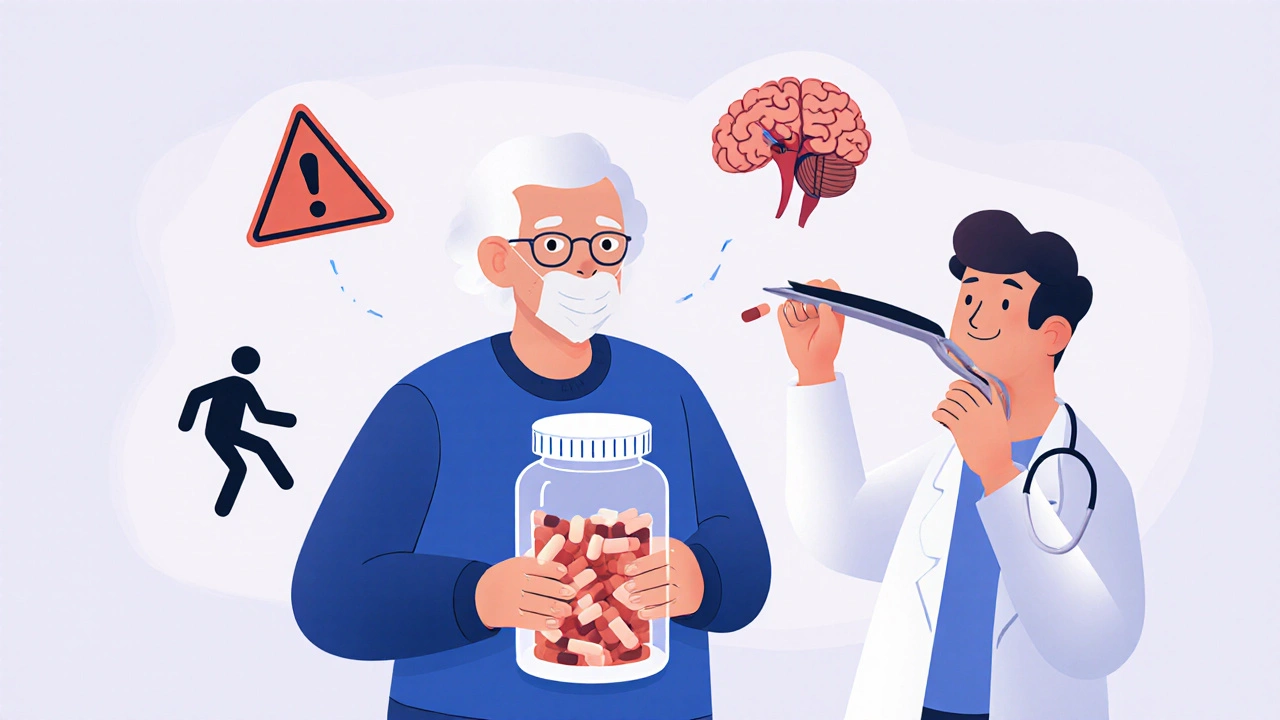
Every year, over 1 in 3 hospital admissions for people over 65 are caused by medication problems. Not because they didn’t take their pills, but because the pills themselves were dangerous for their age. This isn’t rare. It’s systemic. And it’s fixable.
Why Older Adults Are at Higher Risk
As we age, our bodies change in ways that make medications behave differently. The liver and kidneys don’t process drugs as quickly. Body fat increases while water content drops. This means a dose that was safe at 50 can become toxic at 75. A single pill that’s fine for a younger person can cause confusion, falls, or kidney failure in someone older.Then there’s polypharmacy-the habit of taking five, ten, or even more medications at once. It’s common. About 40% of adults over 65 take five or more prescription drugs daily. Many of these were prescribed by different doctors, over years, without ever being reviewed as a whole. The result? Dangerous interactions. Duplicate prescriptions. Drugs that no longer serve a purpose but keep getting refilled.
The numbers are stark. Older adults are 91% more likely to be hospitalized because of a bad drug reaction. They’re 60% more likely to lose mobility or independence after a medication error. And if they’re prescribed a potentially inappropriate medication (PIM), their risk of a serious adverse event jumps by 26%-and gets worse with every extra PIM.
The Beers Criteria: The Gold Standard for Safe Prescribing
Since 1991, the American Geriatrics Society (AGS) has published the Beers Criteria®-a living guide that tells clinicians which drugs to avoid in older adults. The latest version, updated in 2023, lists 139 medications or classes that pose too much risk for most people over 65.Some are obvious: benzodiazepines like diazepam for sleep, or anticholinergics like diphenhydramine (Benadryl) for allergies. These can cause delirium, falls, and memory loss. Others are less expected. Tramadol, once seen as a safer opioid, is now flagged because it can trigger dangerous drops in sodium levels-especially when mixed with diuretics or antidepressants. Even aspirin, long thought to be harmless, is now cautioned against for primary heart disease prevention in people over 70, because bleeding risks outweigh benefits.
What makes the Beers Criteria powerful isn’t just the list-it’s how it’s used. Epic, the biggest electronic health record system in the U.S., now includes Beers Criteria alerts in 87% of its geriatric-focused installations. When a doctor tries to prescribe a flagged drug, the system pops up a warning. Sounds smart, right? But here’s the catch: in many hospitals, these alerts fire for every patient over 65-even when the drug is perfectly appropriate, like warfarin for atrial fibrillation. Clinicians start ignoring them. One emergency doctor reported override rates of 65%. Alert fatigue is real. And it kills.
The Missing Piece: What to Prescribe Instead
For years, doctors knew what not to give. But they didn’t know what to give instead. That changed in July 2025, when the AGS released the Beers Criteria® Alternatives List.This isn’t just a list of safer drugs. It’s a toolkit. It gives 47 evidence-backed alternatives across 12 categories. For insomnia? Try cognitive behavioral therapy (CBT-I), not zolpidem. For chronic pain? Consider physical therapy, acetaminophen at safe doses, or topical NSAIDs instead of oral opioids. For overactive bladder? Pelvic floor exercises, not oxybutynin.
Here’s the kicker: 38% of the alternatives aren’t drugs at all. They’re behavioral, physical, or environmental changes. And that’s the point. Geriatric care isn’t about adding more pills-it’s about removing the ones that hurt and replacing them with real solutions.
A 2023 survey of 1,200 primary care doctors found that 68% struggled to find safe alternatives when trying to stop a PIM. The Alternatives List answers that. It turns a problem into a plan.
How Emergency Departments Are Leading the Change
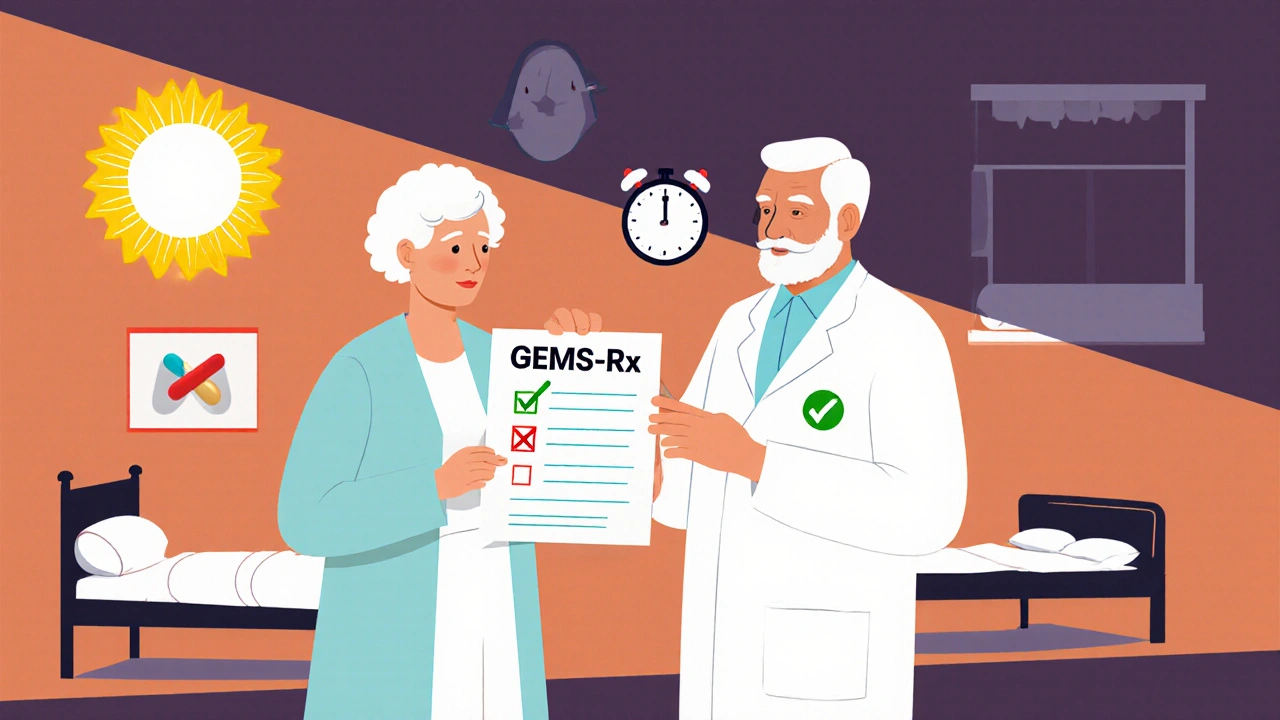
Emergency rooms are where many older adults first get caught in the medication trap. They come in with a fall, confusion, or nausea-and leave with a new prescription that makes things worse.That’s why the Geriatric Emergency Medication Safety Recommendations (GEMS-Rx) were created in March 2024. It’s a focused set of guidelines for ED discharge. It targets eight high-risk classes: antipsychotics, benzodiazepines, anticholinergics, NSAIDs, opioids, and others. It gives ED staff a quick checklist to review before sending someone home.
Results are clear. In a July 2025 survey of 850 emergency physicians, 72% said GEMS-Rx cut high-risk prescribing by 29%. At Mayo Clinic’s ED, a team of pharmacists, geriatricians, and ER doctors slashed PIMs by 38% in six months. But it didn’t happen overnight. They spent 12 weeks training staff, redesigning workflows, and adding pharmacist-led medication reviews at discharge.
And it’s not just about stopping bad drugs. It’s about catching the ones that were never started. The STOPP/START criteria (Screening Tool of Older Person’s Prescriptions/Screening Tool to Alert Doctors to Right Treatment) look for both inappropriate prescriptions and missed opportunities. For example: an older adult with osteoporosis not on a bone-strengthening drug. Or someone with heart failure not on an ACE inhibitor. START fills those gaps.
What Works in Practice: The Teams That Get Results
The most effective programs don’t rely on software alerts alone. They rely on people.A 2025 JAMA Network Open meta-analysis found that when clinical pharmacists and geriatricians worked directly with ER teams, PIM reduction hit 37.2%. Alone, computerized alerts only achieved 22.1%. Why? Because humans can judge context. A machine doesn’t know if a patient’s daughter is their main caregiver. Or if they’ve been on a drug for 15 years with no side effects. Or if they’re in hospice and need comfort over caution.
Successful programs share three traits:
- They have a dedicated pharmacist on the team-ideally one with Board Certification in Geriatric Pharmacy (BCGP). There are only 1,247 of these specialists nationwide.
- They use structured tools: deprescribing scripts, quick-reference cards, and checklists built into the workflow.
- They don’t stop at discharge. They connect with primary care to ensure continuity.
At the University of Alabama at Birmingham, pharmacist-led medication reconciliation cut 30-day readmissions for ADEs by 22%. At Mayo, they reduced high-risk prescriptions by nearly half. These aren’t outliers. They’re models.
The Real Barriers: Alerts, Time, and Training
It’s not all progress. Many hospitals still struggle.63% of hospitals surveyed in early 2025 said integrating Beers Criteria into their EHRs was a nightmare. Alerts are too broad. Too loud. Too frequent. Some systems flag a drug even when the patient has a clear, documented reason to take it-like NSAIDs for severe arthritis. That’s not safety. That’s noise.
Then there’s time. Most primary care visits last 15 minutes. Deprescribing takes longer. It requires asking: Why are you on this? Is it still helping? What happens if we stop? Few doctors feel trained to have these conversations.
Training helps. The Geriatric ED Guidelines 2.0 recommend at least 8 hours of focused education. But only 3.2% of pharmacists specialize in geriatrics-despite the fact that older adults take 16% of all prescriptions. The workforce gap is real.
And then there’s the risk of overcorrection. Dr. Joanne Schnur warned in JAMA Internal Medicine that blindly removing all PIMs can harm frail patients with limited life expectancy. A drug that’s risky for a healthy 75-year-old might be the only thing keeping a 90-year-old with dementia from screaming in pain. Context matters. Goals matter.
What’s Coming Next
The field is evolving fast. In 2026, CMS will expand its Measure 238 to track not just dangerous prescriptions, but also deprescribing events. That’s huge. It means stopping a bad drug will count as a quality improvement.The AGS is also working on ‘Beers Criteria Digital Integration Standards’ for 2026-AI-driven alerts that understand clinical context before firing. Imagine a system that knows this 72-year-old has atrial fibrillation and a history of stroke, so warfarin isn’t a red flag. That’s the future.
And the demand is growing. By 2030, 74 million Americans will be over 65. Medication-related problems are projected to cost $528.4 billion annually by then. Without change, they’ll become the biggest driver of geriatric healthcare spending.
What You Can Do
If you’re caring for an older adult-whether a parent, spouse, or patient-ask these questions:- Why is this medication still being taken?
- Has it been reviewed in the last six months?
- Is there a non-drug option we could try first?
- What happens if we stop it?
Don’t assume it’s safe just because it’s been prescribed for years. Don’t let a doctor dismiss your concern with, ‘It’s fine.’ If a drug is on the Beers Criteria list, it’s not fine. And there’s always a better way.
Geriatric medication safety isn’t about limiting care. It’s about respecting it. It’s about giving older adults the dignity of being treated with care-not just pills.
What are potentially inappropriate medications (PIMs) for older adults?
Potentially inappropriate medications (PIMs) are drugs that carry more risk than benefit for older adults due to age-related changes in metabolism, increased sensitivity, or dangerous interactions. Examples include benzodiazepines (like diazepam), anticholinergics (like diphenhydramine), NSAIDs (like ketorolac), and certain opioids (like meperidine). The 2023 AGS Beers Criteria® lists 139 such medications or classes, with specific warnings based on health conditions, kidney function, or drug combinations.
Can I stop my elderly parent’s medication on my own?
No. Stopping medications without medical supervision can be dangerous. Some drugs, like blood pressure or seizure medications, can cause serious withdrawal effects if stopped suddenly. Always talk to a doctor or pharmacist first. They can help determine if a medication is still needed and create a safe tapering plan if it’s time to discontinue.
What is the AGS Beers Criteria Alternatives List?
Released in July 2025, the AGS Beers Criteria® Alternatives List provides evidence-based options to replace potentially inappropriate medications. It includes 47 recommendations across 12 categories, with 38% being non-drug therapies like physical therapy, cognitive behavioral therapy for insomnia, or dietary changes. It’s designed to help clinicians make safer prescribing decisions by offering clear alternatives, not just warnings.
How does CMS Measure 238 affect geriatric care?
CMS Measure 238, effective in 2025, tracks how often older adults are prescribed two or more high-risk medications from the same drug class-like two different benzodiazepines or two NSAIDs. Hospitals must report this data, and poor performance can reduce Medicare reimbursements. This pushes providers to review prescriptions for duplication and unnecessary overlap, directly improving safety.
Are there safe alternatives to sleeping pills for seniors?
Yes. The AGS Alternatives List recommends cognitive behavioral therapy for insomnia (CBT-I) as the first-line treatment. Other safe options include improving sleep hygiene-like consistent bedtimes, reducing evening caffeine, and getting morning sunlight. If medication is needed, low-dose melatonin or ramelteon are preferred over benzodiazepines or ‘Z-drugs’ like zolpidem, which increase fall and confusion risks.
Why is deprescribing important in elderly care?
Deprescribing means intentionally stopping medications that are no longer beneficial or are causing harm. Older adults often take drugs that were prescribed years ago for conditions that have changed or resolved. Many of these drugs increase fall risk, cognitive decline, or kidney stress. Deprescribing reduces side effects, improves quality of life, and can even restore mobility and alertness. Studies show multidisciplinary teams can achieve up to a 42% deprescribing rate when done properly.

Charity Peters
November 27, 2025 AT 23:29My grandma was on like 12 meds and now she’s actually sleeping through the night. No more zolpidem. Just a walk after dinner and a warm tea. Game changer.
Faye Woesthuis
November 28, 2025 AT 04:24If you’re still prescribing benzos to seniors, you’re not a doctor-you’re a liability.
ka modesto
November 29, 2025 AT 14:39I’ve been a geriatric pharmacist for 18 years and this post nails it. The Beers Alternatives List? Lifesaver. I hand out printed copies to families now. One mom told me her dad stopped falling after they ditched the anticholinergic for bladder issues. No more diapers, no more fear. Just walking in the garden again. That’s the win.
And yeah, EHR alerts are garbage-half of them fire for warfarin or insulin. We’ve trained our staff to override with a note: ‘Clinical justification: atrial fibrillation, CHF, stable INR.’ That’s how you fight alert fatigue.
But the real magic? Having a pharmacist sit with the ER doc at discharge. Not just a pop-up. A conversation. We ask: ‘What’s the goal here?’ For some, it’s comfort. For others, it’s independence. You can’t code that.
And don’t get me started on the workforce gap. There are 1,247 geriatric pharmacy specialists in the entire U.S. We need 10,000. And training? Most med schools still treat geriatrics like an elective. It’s not a specialty-it’s the future.
Deprescribing isn’t about taking meds away. It’s about giving people back their lives. One less pill, one more sunrise.
Crystal Markowski
November 30, 2025 AT 19:33It’s heartening to see systemic change finally being prioritized in geriatric care. The shift from reactive prescribing to intentional deprescribing represents a profound evolution in medical ethics. When we recognize that less can be more, we honor the dignity of aging individuals rather than pathologizing their natural physiology.
The inclusion of non-pharmacological alternatives-CBT-I, pelvic floor therapy, sunlight exposure-is not merely pragmatic; it’s humanistic. It acknowledges that health is not solely the absence of disease, but the presence of well-being.
That said, implementation remains uneven. Hospitals with limited resources struggle to integrate pharmacist-led reviews. We must advocate for policy that funds these roles, not just alerts. Technology without human judgment is noise. Human judgment without systems to support it is unsustainable.
Let us not mistake compliance for care. A patient who takes every pill is not necessarily a well patient. A patient who sleeps, walks, and remembers their grandchild’s name-that’s the metric that matters.
Kelly Yanke Deltener
December 2, 2025 AT 10:47Ugh, another liberal medical elitist post pretending old people are fragile little china dolls. My grandpa was 82 and still drove, fished, and drank his whiskey. You think taking away his meds is helping? He had a right to feel good-even if it’s a little pill. Stop infantilizing seniors.
And why do we always blame doctors? Maybe the problem is that people live too long now. If you’re 90 and your kidneys are shot, maybe you shouldn’t be on 10 drugs. But don’t blame the doc. Blame the fact that we keep people alive past their expiration date.
Kevin Mustelier
December 4, 2025 AT 04:56Ah yes, the Beers Criteria. The holy scripture of geriatric medicine. 🙄
Let me guess-next they’ll ban aspirin because it might cause a bleed in someone who’s 90 and already on hospice? What’s next? Mandatory life reviews before prescribing Tylenol?
At what point do we stop treating the elderly like broken machines and start treating them like people who’ve lived? I mean… isn’t the point of aging to have the freedom to take your own risks?
Also, who funded this? Big Pharma? Because I’m starting to smell a non-drug agenda.
raja gopal
December 5, 2025 AT 19:59From India, I just want to say-this is so needed. In my village, grandmas are given 8-10 pills every day because the doctor says ‘better safe than sorry.’ No one checks. No one asks. One lady stopped walking because of the diuretic. Her family thought she was just getting old.
But when we showed the family the Beers list, they asked the doctor to review everything. Two weeks later, she was dancing at her granddaughter’s wedding. No meds. Just tea, sun, and laughter.
We don’t need fancy tech. We need someone to care enough to listen.
Samantha Stonebraker
December 6, 2025 AT 03:49There’s a quiet revolution happening in geriatrics-one that doesn’t scream, doesn’t trend, and doesn’t need a hashtag. It’s the moment a nurse pauses before handing over a script and says, ‘Let’s talk about why you’re on this.’
I’ve seen it: the man who stopped taking his sleep med and started reading poetry before bed. The woman who swapped her NSAID for weekly tai chi and no longer winces when she stands. These aren’t victories of medicine. They’re victories of presence.
Technology can warn. But only a human can wonder: ‘What do you miss when you’re doped up?’
Maybe the real alternative isn’t on the list. Maybe it’s silence. Space. Time. And someone who remembers you’re not a diagnosis.
Keith Avery
December 7, 2025 AT 03:14Let’s be honest-this whole Beers Criteria thing is just a bureaucratic band-aid for lazy prescribing. The real problem? Doctors don’t know pharmacology. They’re trained to write scripts, not think. And now we’re slapping on AI alerts like a Band-Aid on a hemorrhage.
Also, ‘non-drug alternatives’? CBT-I? Pelvic floor exercises? You’re asking a 78-year-old with arthritis and dementia to do yoga? Please. The system is broken, but this isn’t fixing it-it’s just making doctors feel better about prescribing less.
Real solution? Train doctors better. Pay them more. Stop treating geriatrics like a side project.
Luke Webster
December 8, 2025 AT 08:13I’m from a rural town in Alabama, and our clinic just started doing pharmacist-led med reviews. We didn’t even have a computer alert. Just a whiteboard, a checklist, and a pharmacist who knew everyone’s name.
One man had been on diazepam for 18 years because his wife said he was ‘nervous.’ Turns out he was just lonely. We got him connected to the senior center. He started playing chess on Tuesdays. Stopped the benzo. Now he brings cookies to the nurse’s station.
You don’t need AI to fix this. You need a community that shows up.
Holly Lowe
December 10, 2025 AT 07:09OMG I JUST SAW THIS ON MY MOM’S PHARMACY PRINTOUT AND I WAS LIKE-WAIT. SHE’S ON THREE BEERS CRITERIA DRUGS?! I THOUGHT THEY WERE JUST ‘OLD PEOPLE MEDS’!!
WE’RE GOING TO THE DOCTOR TOMORROW. I’M TAKING A LIST. I’M BRINGING COFFEE. I’M NOT TAKING NO FOR AN ANSWER.
MY MOM DESERVES TO WALK WITHOUT FALLING. NOT JUST SURVIVE. LIVE.
Cindy Burgess
December 12, 2025 AT 00:48The empirical evidence presented here is compelling, yet the rhetorical framing borders on alarmist. The Beers Criteria, while clinically valuable, are not universally applicable. The 2023 iteration exhibits a degree of overcorrection, particularly in its conflation of polypharmacy with iatrogenesis. Furthermore, the assertion that non-pharmacological interventions are ‘preferred’ lacks sufficient comparative effectiveness data across heterogeneous geriatric populations. One must question whether the emphasis on deprescribing inadvertently undermines the autonomy of patients who derive subjective benefit from pharmacological regimens-even if statistically elevated in risk.
Moreover, the implicit moral imperative embedded in the text-‘you must stop these drugs’-risks pathologizing normal aging. A 90-year-old with dementia may not require a ‘safe’ alternative to an antipsychotic if the alternative is unrelenting agitation. Contextual nuance is not a loophole-it is the essence of medical ethics.
Tressie Mitchell
December 13, 2025 AT 22:28Of course the ‘experts’ want to take away all the pills. They don’t want to treat old people-they want to control them. You think your grandma wants to do ‘pelvic floor exercises’ instead of sleeping? You’re not helping. You’re just making her feel guilty for needing help.
And who are you to decide what’s ‘appropriate’? My aunt’s on tramadol and she’s happy. That’s all that matters. Stop playing God with medicine.