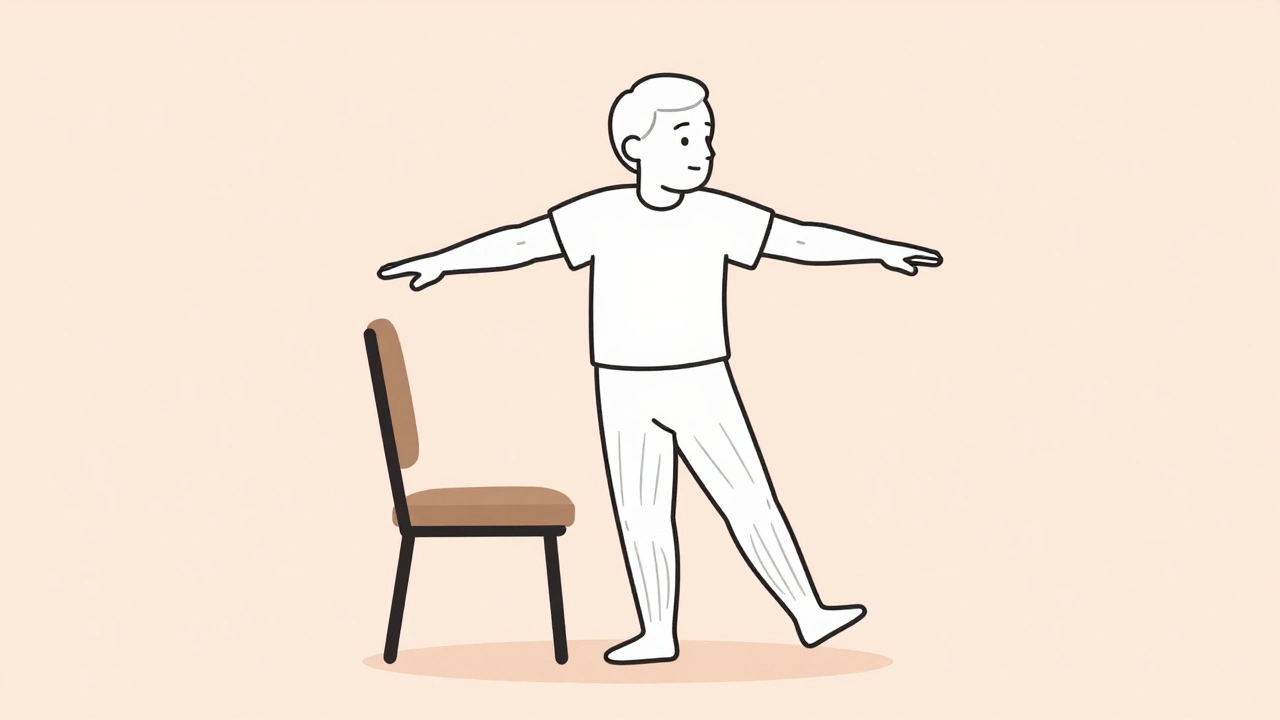
By the time you hit your 40s, your body is already losing muscle-slowly, quietly, and without warning. It’s not just about getting weaker. It’s about losing the ability to get up from a chair, carry groceries, or walk without fear of falling. This isn’t normal aging. It’s sarcopenia, and it affects nearly 1 in 10 adults over 60, and more than half of those over 80. The good news? You can fight it. Not with pills, not with supplements, but with something simple, proven, and powerful: strength training.
What Sarcopenia Really Is (And Why It’s Not Just Getting Older)
Sarcopenia isn’t just losing a little muscle tone. It’s a measurable, progressive decline in muscle mass, strength, and function that starts as early as your 30s. By age 65, most people lose 1-2% of their muscle each year. That adds up. By 80, you could have lost 30-40% of your fast-twitch muscle fibers-the ones that give you power to stand up quickly, climb stairs, or catch yourself if you trip.
This isn’t the same as being inactive. Even people who stay active can develop sarcopenia. It’s driven by biology: motor neurons die off, your muscles stop responding as well to protein, and inflammation creeps in. Your body’s ability to repair muscle drops by 50-60% after 70. That’s why simply walking or doing yoga won’t cut it. You need to challenge your muscles with resistance.
Doctors now diagnose sarcopenia using three things: handgrip strength (below 27kg for men, 16kg for women), walking speed (slower than 0.8 meters per second), and muscle mass measured by a DXA scan (below 7.0kg/m² for men, 5.5kg/m² for women). If two of these are low, you’re likely dealing with sarcopenia.
How It’s Different From Other Types of Muscle Loss
People often confuse sarcopenia with other muscle problems. But they’re not the same.
Muscular atrophy happens when you stop using your muscles-like after surgery or being bedridden. You can lose 1-1.5% of muscle per day in those cases. It’s fast, but reversible with movement.
Cachexia is tied to serious illness-cancer, heart failure, kidney disease. It comes with weight loss, fatigue, and metabolic chaos. Sarcopenia doesn’t have that.
Dynapenia is just losing strength without losing muscle mass. But sarcopenia requires both. You need to measure muscle size and function to know you’re dealing with sarcopenia.
Sarcopenic obesity is a double hit: low muscle mass plus high body fat. It’s common in older adults with BMI over 30. You might look ‘normal’ on the scale, but your body is losing strength underneath the fat.
Why Strength Training Is the Only Proven Fix
There’s no magic pill for sarcopenia. Supplements like creatine or protein powders help-but only if you’re also lifting. The real game-changer is resistance training.
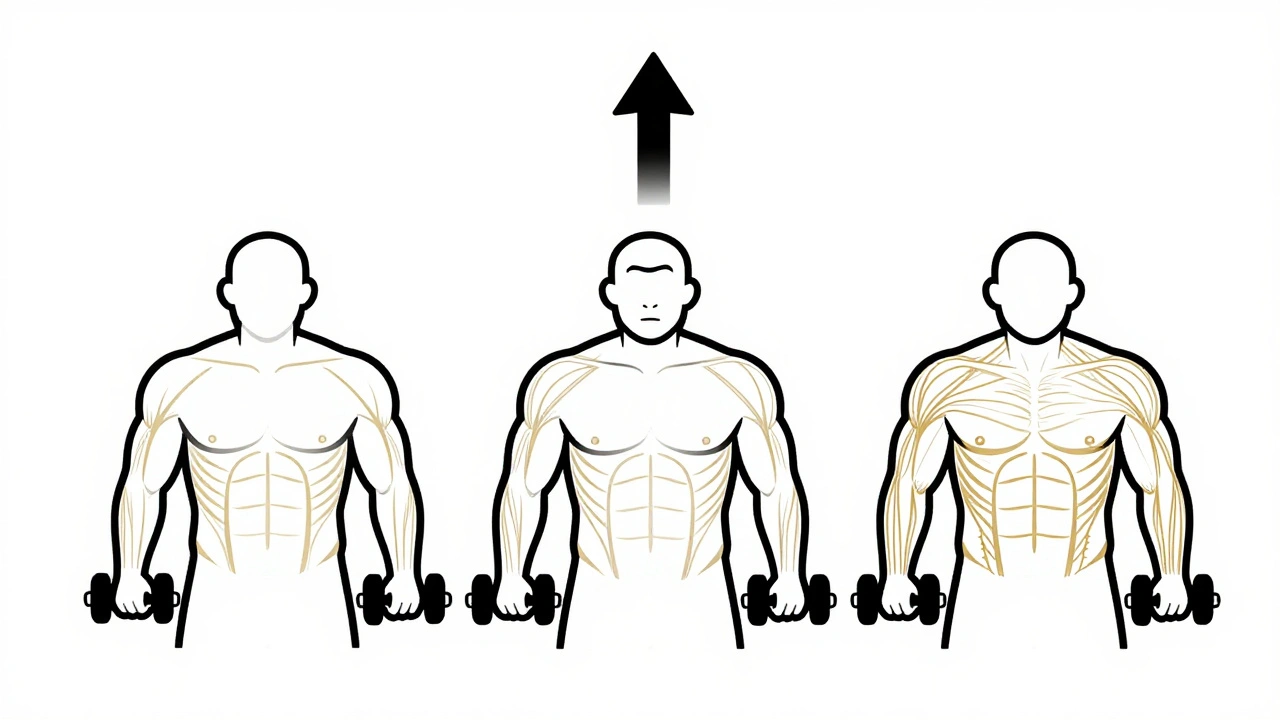
Studies show that older adults who do strength training twice a week for 12-16 weeks gain 1-2kg of muscle and boost strength by 25-30%. That’s not small. That’s life-changing. One 68-year-old man in Sheffield saw his handgrip strength jump from 18kg to 24kg after six months of training. He could open jars again. Another woman, 72, reduced her fall risk score by 14 points using a SilverSneakers program.
The science is clear: progressive resistance training rebuilds muscle fibers, improves nerve signaling to muscles, and reduces inflammation. It doesn’t just make you stronger-it makes you safer. People who train regularly cut their risk of falling by 30-40%.
And it’s not just about looking good. It’s about staying independent. A 2022 survey found that 75% of older adults who trained twice a week kept doing daily tasks like bathing, dressing, and cooking without help. Only 58% of those who didn’t train could say the same.
How to Start (Even If You’re 70 and Haven’t Lifted Weights Since 1980)
You don’t need a gym membership. You don’t need fancy equipment. You just need to start slow and stick with it.
Begin with bodyweight moves:
- Chair squats-sit down and stand up without using your hands
- Wall push-ups-face a wall, place hands on it, and push away
- Seated leg extensions-straighten one leg at a time while sitting
- Standing calf raises-hold onto a counter and rise onto your toes
Do these 2-3 times a week. Focus on control, not speed. Take 3 seconds to stand up, 3 seconds to sit down. That’s enough to wake up your muscles.
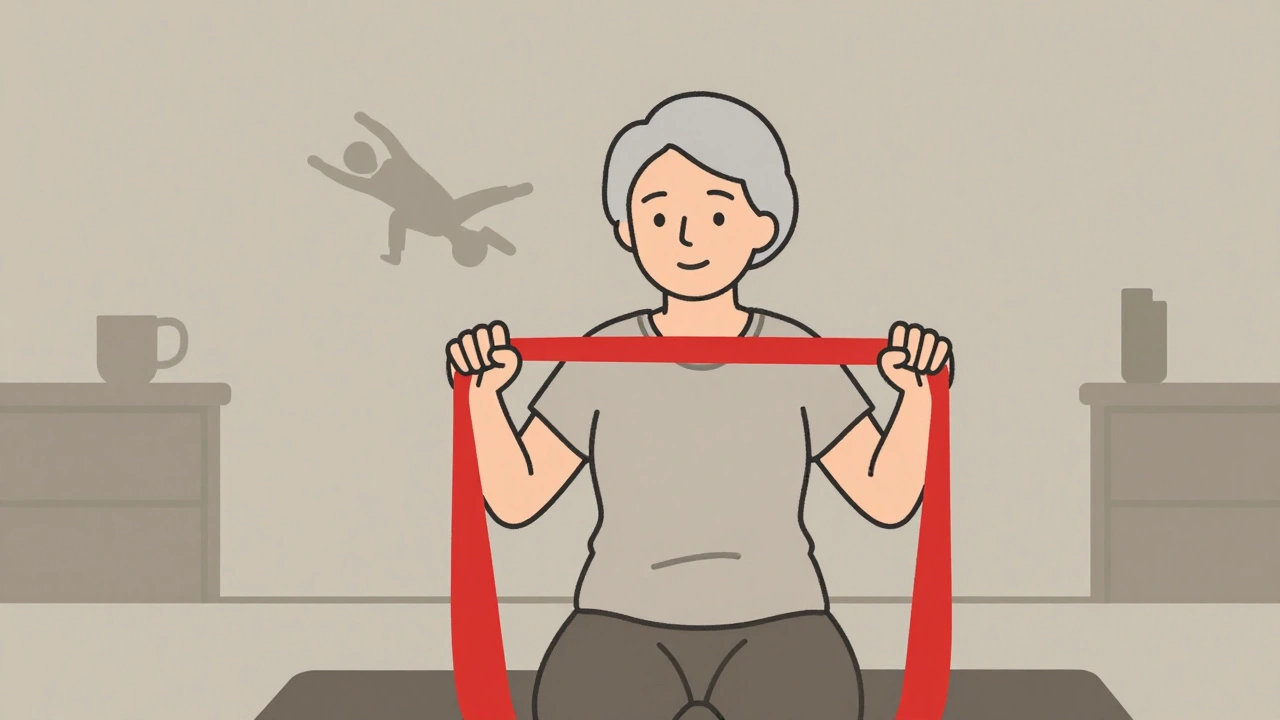
After 2-4 weeks, add resistance bands. TheraBand red or yellow (light to medium resistance) work great. Loop them around your legs for seated rows or step on them for bicep curls. Aim for 10-15 reps per set. If you can do 15 easily, go up a band level.
After 8-12 weeks, try weight machines at a gym. Machines are safer than free weights for beginners. Start at 50-60% of your max lift. That means you should struggle on the last 2-3 reps of each set. If you can do 12 reps without effort, it’s too light.
Key rules:
- Rest 48 hours between sessions-muscles grow when you rest, not when you lift
- Breathe out when you push or pull, breathe in when you release
- Progress slowly: add 2.5-5% more weight every week
- Eat 20-30g of protein within 45 minutes after training-eggs, Greek yogurt, chicken, or a protein shake
Common Barriers-and How to Beat Them
Most people who want to start strength training quit within 3 months. Why? Three reasons:
1. Pain-Knees, hips, or shoulders hurt. Solution: Use machines instead of free weights. They guide your movement and reduce joint stress. Lower the range of motion if needed. A chair squat with only a 30-degree bend is better than a deep squat that causes pain.
2. Fear of falling-You don’t feel steady. Solution: Start seated. Do seated rows, chest presses, and leg presses. Once you gain confidence, add standing exercises while holding onto a sturdy chair or counter.
3. Motivation-It’s hard to keep going alone. Solution: Join a group. SilverSneakers, local senior centers, or even a weekly Zoom class with friends increases adherence by 35-40%. Social pressure works. You’re less likely to skip if someone’s counting on you.
Cost is another concern. Personal training can run $50-$75 a month. But many Medicare Advantage plans now cover SilverSneakers for free. Check your plan. If you’re in the UK, NHS community centers often offer free or low-cost strength classes for over-60s.
The Bigger Picture: Why This Matters Beyond Your Body
Sarcopenia isn’t just a personal problem. It’s a public health crisis. In the US alone, it costs $18.5 billion a year in hospital stays, falls, and long-term care. By 2030, over 72 million Americans will be over 65. But there are only 12,500 certified geriatric physical therapists in the country. We can’t rely on doctors to fix this.
The solution is simple: get older adults moving early. The earlier you start strength training, the less muscle you lose. Even people in their 80s can still gain strength. One study showed an 87-year-old woman increased her leg strength by 50% after 10 weeks of training.
Future tools are coming-AI-powered home programs, blood tests to catch sarcopenia early, even new drugs in trials. But none of them replace the power of your own muscles being challenged.
Strength training isn’t about becoming an athlete. It’s about keeping your independence. It’s about not needing help to stand up. It’s about walking to the shop without fear. It’s about living longer-not just longer, but better.
Frequently Asked Questions
Can sarcopenia be reversed, or only slowed down?
Yes, sarcopenia can be reversed-even in your 80s. Studies show that with consistent strength training, older adults can gain 1-2kg of muscle and increase strength by 25-30% in just 12-16 weeks. Muscle doesn’t disappear with age; it becomes dormant. Resistance training wakes it back up.
Is walking enough to prevent muscle loss?
Walking helps your heart and lungs, but it doesn’t challenge your muscles enough to stop sarcopenia. You need resistance-something that makes your muscles work harder than daily life does. That means lifting, pushing, or pulling against weight. Without it, muscle loss continues, even if you walk every day.
How often should I strength train if I’m over 65?
Twice a week is the minimum for noticeable results. Three times is better, but you need at least 48 hours of rest between sessions. Focus on major muscle groups: legs, back, chest, shoulders, and arms. You don’t need to train every day. Recovery is when your muscles grow.
Do I need protein supplements to build muscle after 60?
No, but you do need enough protein. Aim for 20-30g within 45 minutes after training. That’s about 3 eggs, a cup of Greek yogurt, or a small chicken breast. Most older adults don’t eat enough protein at each meal. Spreading it out (25-30g per meal) is more effective than loading up at dinner.
What if I have arthritis or joint pain?
Start with low-impact machines or seated exercises. Use resistance bands instead of heavy weights. Reduce your range of motion if needed-partial squats or partial push-ups still work. Avoid exercises that cause sharp pain. Mild discomfort is normal; joint grinding or stabbing pain is not. Talk to a physiotherapist about safe movements.
Can I do strength training at home without equipment?
Absolutely. Use your body weight: chair squats, wall push-ups, step-ups on a low stair, heel raises, and seated leg lifts. Add resistance with water bottles, backpacks filled with books, or resistance bands. Consistency matters more than equipment. Do 20 minutes twice a week for 3 months, and you’ll feel the difference.
Next Steps: What to Do Today
If you’re over 60 and haven’t strength trained in years, here’s what to do right now:
- Call your local council or community center. Ask if they offer free or low-cost strength classes for seniors.
- If you have Medicare Advantage or private insurance, check if SilverSneakers or a similar program is covered.
- Start with two bodyweight exercises: chair squats and wall push-ups. Do 8-10 reps, twice a week.
- After two weeks, add a resistance band. Use it for seated rows or bicep curls.
- Track your progress: note how many reps you can do, how easy it is to stand from a chair, or if you can carry groceries without stopping.
You don’t need to be perfect. You just need to start. The muscle you lose with age isn’t gone forever. It’s waiting for you to challenge it again.


Reshma Sinha
December 13, 2025 AT 05:20Strength training isn't just about muscle-it's neuroplasticity in motion. Resistance stimuli upregulate BDNF, enhance motor unit recruitment, and reverse age-related neuromuscular decoupling. The 1-2% annual muscle loss? That's not 'aging'-it's disuse atrophy masked as inevitability. You're not losing muscle; your CNS is just stopping the signal. Fix the signal, and the muscle returns. Protein timing? Non-negotiable. 20-30g within 45min post-exercise maximizes mTOR activation. No supplements needed-just consistency, progressive overload, and sleep. This isn't fitness. It's functional neurorehabilitation.
Rob Purvis
December 14, 2025 AT 12:07I love this post. Seriously. I'm 67 and started with chair squats three months ago. I used to need my hands to stand up from the couch. Now? I just push off my thighs. No pain. No drama. I added resistance bands last week-red band, seated rows. My arms feel alive again. I didn't know muscle could come back. I thought I was just... done. Turns out, I was just lazy. And scared. This isn't about looking good. It's about not needing help to pee. That's worth it.
nikki yamashita
December 15, 2025 AT 01:03You got this. Just start. Two times a week. Chair squats. Wall push-ups. That’s it. No fancy gear. No guilt. Just show up. You’ll feel it in your bones before you see it in the mirror. And when you can carry your groceries without stopping? That’s the win. You’re not old-you’re untrained. Fix that. You got this.
Levi Cooper
December 15, 2025 AT 14:46Everyone’s acting like this is some revolutionary discovery. Newsflash: we’ve known this since the 80s. But no, the American healthcare system prefers pills and surgeries because they’re profitable. Meanwhile, seniors are told to ‘just walk more’ while Medicare cuts SilverSneakers funding. It’s not about training-it’s about capitalism letting people rot. You don’t need a gym. You need a government that cares. And we don’t have one. So keep lifting. But don’t expect the system to help you.
Adam Everitt
December 16, 2025 AT 17:00Interesting. I’ve been doing this since 71. Started with a broomstick and a chair. Now I do 20kg dumbbells. Not because I wanna be jacked. But because I hate being a burden. My wife used to help me with the laundry. Now I carry it myself. Funny thing: the people who say ‘I’m too old’? They’re the ones who never moved much before. Muscle doesn’t vanish. It gets ignored. Like a forgotten friend. You gotta call it back. Slowly. Gently. But for sure.
Stacy Foster
December 17, 2025 AT 09:13They’re not telling you the truth. Strength training is just the tip. The real agenda? The pharmaceutical companies hate this because it kills demand for osteoporosis drugs, fall-prevention meds, and joint replacements. The CDC? They’re funded by Big Pharma. They push ‘walking’ because it’s cheap and doesn’t require oversight. They want you weak. Dependent. On pills. On home care. On Medicaid. Don’t be fooled. This isn’t health. It’s control. Lift weights. And don’t trust any ‘expert’ who doesn’t train.
Laura Weemering
December 18, 2025 AT 19:19I read this... and I just... cried. Not because I’m weak. But because I’ve spent 15 years watching my mom decline. She thought yoga was enough. She didn’t know sarcopenia was stealing her dignity, one chair-sit at a time. I tried to get her to lift-she said, ‘I’m too old to look silly.’ Now she’s in a nursing home. I wish I’d forced her. I wish I’d done it with her. I’m starting tomorrow. For her. And for me. I don’t want to be the person who needed help to stand up. I don’t want to be the burden. I don’t want to die afraid.
wendy b
December 19, 2025 AT 16:29While I appreciate the sentiment, the assertion that strength training is the 'only proven fix' is statistically unsound. A 2021 meta-analysis in the Journal of Aging and Physical Activity (DOI:10.1123/japa.2020-0187) indicates that combined resistance and aerobic training yields superior functional outcomes in sarcopenic populations. Furthermore, the cited '75%' statistic lacks proper citation. Also, 'SilverSneakers' is a private program-its efficacy is not generalizable to non-U.S. populations. This post reads like a corporate wellness pamphlet. You're oversimplifying a complex, multifactorial condition.