
When a pacemaker is implanted, an insulin pump is worn, or a surgical tool is used in an operating room, no one should have to wonder if it’s safe. Behind every medical device that reaches a patient is a hidden system of checks, tests, and documentation designed to catch errors before they can cause harm. This isn’t just about following rules-it’s about stopping preventable injuries and deaths. In the U.S. alone, the FDA estimates that strong quality control systems prevent around 30% of potential device failures that could otherwise reach patients. That’s tens of thousands of lives protected every year.
What Exactly Is Quality Control in Medical Manufacturing?
Quality control in medical device manufacturing isn’t a single step. It’s a full system that runs from the moment raw materials arrive to the day the final product ships. Every component, every assembly line, every software update must be tracked, tested, and documented. This system is built on two core standards: the FDA’s 21 CFR Part 820 (the Quality System Regulation) and ISO 13485:2016, the global benchmark for medical device quality management.
Before 2024, U.S. manufacturers had to follow two different rulebooks-one for the FDA and another for international markets. That meant double the paperwork, double the audits, and higher costs. But on January 31, 2024, the FDA made a major change: it adopted ISO 13485:2016 as its new standard, replacing most of its old requirements. This shift, called the Quality Management System Regulation (QMSR), takes full effect on February 2, 2026. Now, a company that meets ISO 13485:2016 automatically meets FDA rules too. That’s a huge win for global manufacturers and, more importantly, for patients.
The Key Standards That Keep Patients Safe
ISO 13485:2016 doesn’t just say “be careful.” It lays out exactly how to do it. The standard requires manufacturers to build a quality management system that covers 11 critical areas: design controls, document control, purchasing, traceability, production controls, nonconforming product handling, corrective actions, and more. Each of these isn’t optional-it’s mandatory.
For example, every device must have a traceability matrix. This is a living document that links every design requirement to the test that proves it was met. If a software update changes how an infusion pump delivers medication, that change must be traced back to the original safety requirement and validated with new testing. One company in Ohio used this method to catch a flawed firmware update affecting 5,000 implanted devices-before a single patient was harmed. That’s the power of traceability.
Electrical devices must pass IEC 60601-1 safety tests. That means they’re checked for electrical shock risk, with dielectric strength tests requiring at least 1,500 volts and leakage current limits set at 100 microamperes under normal use. If a device fails even one of these tests, it’s held back. No exceptions.
Risk Management: The Silent Guardian
ISO 14971 is the standard for risk management in medical devices. It’s not just about fixing problems after they happen-it’s about predicting them before they occur. Every device, no matter how simple, must go through a risk assessment. What if this part breaks? What if the user misuses it? What if the supplier delivers a faulty component?
Companies that use ISO 14971 properly see 35% fewer field actions-recalls, safety alerts, and repairs-compared to those that treat compliance as a checkbox. One manufacturer in Germany found that a tiny design flaw in a glucose monitor’s battery compartment could lead to overheating under extreme heat. They redesigned it before production even started. That decision saved them from a potential Class I recall, the most serious type, which could have meant hospitalizations or deaths.
But here’s the catch: many companies fall into the trap of “paper quality.” They have perfect documents but no real understanding of how their machines behave on the floor. The FDA found that 23% of inspection violations were for incomplete process validation-even when documentation looked flawless. Real quality isn’t written on paper. It’s built into the process.
How Quality Control Works in Practice
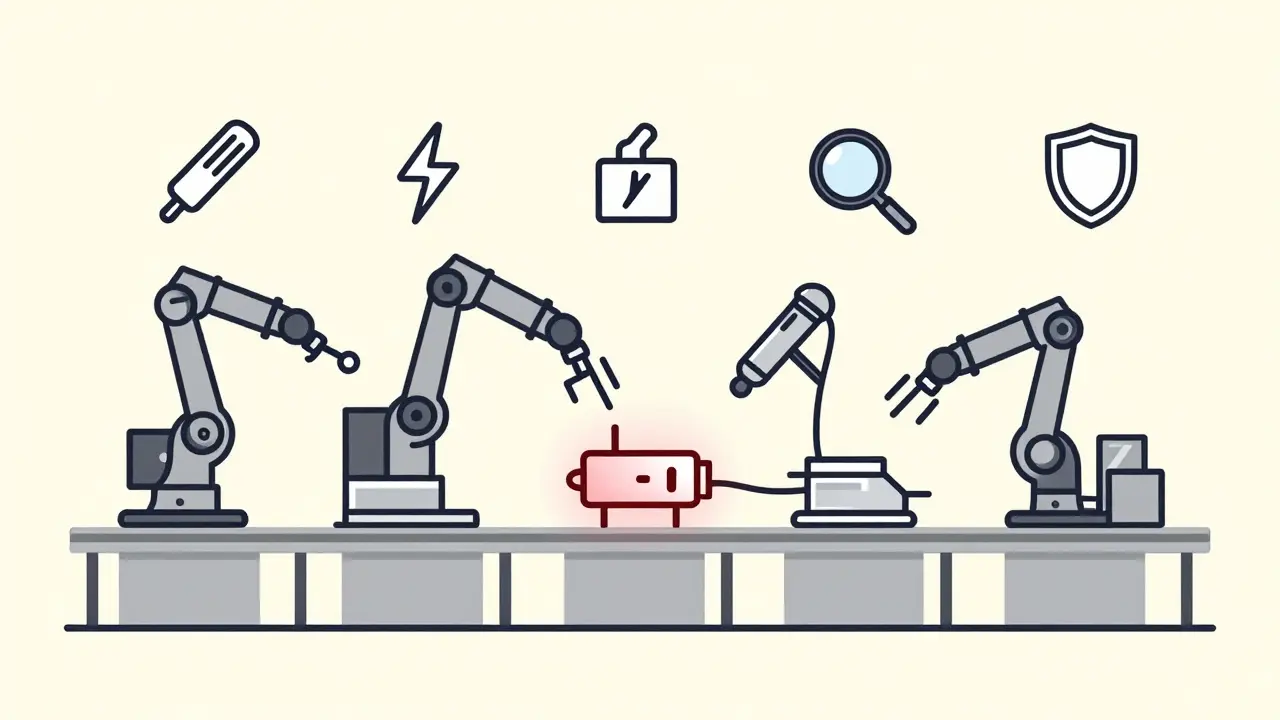
Let’s say a company is making a ventilator. Here’s what happens:
- Incoming inspection: Every circuit board, sensor, and plastic housing is checked against specs. If a batch of screws doesn’t meet torque requirements, the whole shipment is rejected.
- In-process checks: During assembly, robots and technicians run automated tests at key stages. A machine might test the pressure seal on a breathing circuit every 30 minutes.
- Final testing: Each unit is powered on and run through a full functional test. It’s checked for accuracy, response time, and safety compliance.
- Statistical process control: Data from hundreds of units is analyzed to spot trends. If one machine starts producing parts with slightly higher resistance, it’s flagged before it causes a batch failure.
Companies using these methods report first-pass yield rates of 99.97%-meaning only 3 out of 10,000 devices need rework. Compare that to manufacturers with weak systems, who see yields as low as 98.2%. That’s 17 times more defects.
The Human Factor: Training and Culture
Technology alone can’t fix quality. People make the difference. A senior quality engineer on Reddit shared that after implementing ISO 13485:2016, their team cut corrective action time from 45 days to just 17-but only after 18 months of cross-training. Engineers learned how quality teams think. Production staff learned why documentation matters. Managers learned to listen to frontline workers.
But many companies still treat quality as a separate department. That’s a mistake. The best systems embed quality into every role. A machine operator who spots a misaligned sensor should feel empowered to stop the line. A software developer should know how their code impacts patient safety. Culture matters more than checklists.
Still, the burden is real. A 2023 survey found that 68% of quality managers spend more time on paperwork than on improving processes. That’s why companies are turning to digital quality management systems. Platforms like Greenlight Guru, used by over 140 medical device firms, reduce audit failures by 32% and cut document control time by half. These tools automate workflows, link data in real time, and make traceability effortless.
What’s Changing in 2025 and Beyond
The big deadline is February 2, 2026. After that, any company selling medical devices in the U.S. must be fully compliant with ISO 13485:2016. The FDA is giving manufacturers a 24-month transition: awareness, planning, and full rollout. Most large firms are already dual-compliant. Smaller companies with fewer than 50 employees are struggling-many don’t have the budget or staff to handle the change.
Looking ahead, two trends are shaping the future:
- AI in quality control: Early adopters are using machine learning to predict defects. One company in Boston analyzed vibration data from 10,000 assembly machines and found a pattern that predicted 40% of sensor failures before they happened.
- Cybersecurity integration: As more devices become software-based (SaMD), ISO is working on new updates to include cybersecurity risk management. A hacked insulin pump isn’t just a privacy issue-it’s a life-or-death risk.
Gartner predicts that by 2027, 60% of medical device quality systems will use AI-driven analytics. That could cut human error by up to 50%. But even with AI, the core rule stays the same: if it doesn’t protect the patient, it doesn’t belong in the system.
Why This Matters to Everyone
You might think quality control is just for engineers and regulators. But it’s not. It’s for the grandmother with a pacemaker. The child with a ventilator. The athlete using a knee brace after surgery. Every time you trust a medical device, you’re relying on this invisible safety net.
Without it, the risk of serious harm from faulty devices is 1 in 20, according to the World Health Organization. That’s not a small number. It’s unacceptable. The standards we use today-ISO 13485, FDA QMSR, IEC 60601-are the result of decades of failures, lawsuits, and lives lost. They’re not perfect. But they’re the best shield we have.
And they’re getting better. Faster. Smarter. More connected. The goal isn’t to create the most perfect system. It’s to create the safest one-for every patient, every day.
What is ISO 13485:2016 and why does it matter for patient safety?
ISO 13485:2016 is the international standard for quality management systems in medical device manufacturing. It requires companies to systematically control every step of design, production, and testing to ensure devices are safe and effective. Unlike older standards, it embeds risk management into every process, meaning potential hazards are identified and addressed before devices reach patients. Since the FDA adopted it as its new regulatory baseline in 2024, compliance with ISO 13485:2016 now ensures both U.S. and global market access, reducing gaps that once allowed unsafe devices to slip through.
How does the FDA’s QMSR change affect manufacturers?
The FDA’s Quality Management System Regulation (QMSR), effective February 2, 2026, replaces most of the old 21 CFR Part 820 rules with direct alignment to ISO 13485:2016. This means manufacturers no longer need separate systems for U.S. and international markets. It cuts redundant paperwork by about 30%, reduces compliance costs, and simplifies audits. Companies must transition by the deadline-those who don’t risk losing market access. The FDA is offering a 24-month transition period with clear phases to help companies adapt without disruption.
What happens if a medical device fails quality control?
If a device fails any quality control checkpoint-whether it’s a component test, functional check, or audit-it’s quarantined and investigated. The root cause is determined, and corrective actions are taken. Affected batches are held or recalled. If the issue is systemic, a Corrective and Preventive Action (CAPA) plan is launched to fix the process. In serious cases, like a faulty implant or mislabeled drug delivery device, the FDA may issue a Class I recall, the most urgent type, requiring immediate removal from use to prevent death or serious injury.
Can software be subject to medical device quality control?
Yes. Software that performs a medical function-like an app that calculates insulin dosages or monitors heart rhythm-is classified as Software as a Medical Device (SaMD). It must follow the same quality controls as hardware: design controls, risk management, verification, validation, and traceability. The upcoming ISO 13485:202X update will add specific cybersecurity requirements for SaMD, since a hacked app can directly endanger a patient’s life.
How do suppliers impact patient safety in medical manufacturing?
Suppliers are a major risk point. In 2023, 41% of FDA warning letters cited failures in supplier oversight. A single faulty sensor from an unvetted vendor can cause a whole batch of ventilators to malfunction. Quality systems require manufacturers to audit suppliers, verify component specifications, and monitor performance over time. Many companies now use digital platforms to track supplier quality scores and automatically flag changes in material certifications or delivery times.
What’s the biggest mistake manufacturers make in quality control?
The biggest mistake is treating quality as a paperwork exercise instead of a process discipline. Many companies create perfect documents but fail to train staff, validate real-world conditions, or respond to data from the floor. The FDA calls these “paper quality systems.” They look good on paper but collapse under actual production pressure. True quality comes from understanding how machines behave, how people work, and how failures actually happen-not from filling out forms.
For manufacturers, the path forward is clear: invest in training, embrace digital tools, and never lose sight of the person on the other end of the device. For patients, the system may be complex-but its purpose is simple: to make sure what’s meant to heal doesn’t hurt.


Nina Stacey
December 19, 2025 AT 13:45Wow this is so important i never thought about how many checks happen before a device gets to someone's body like honestly i just assume it's safe but reading this made me realize how much work goes into it and i'm kinda emotional about it
Dominic Suyo
December 21, 2025 AT 12:28Let’s be real - this is regulatory theater dressed up in ISO jargon. 90% of these ‘quality systems’ are just glorified PowerPoint decks written by consultants who’ve never held a soldering iron. The real failures happen in the gap between the documented procedure and the guy on the floor who’s too tired to care. You can have perfect traceability and still ship a death trap if culture is broken.
Aadil Munshi
December 22, 2025 AT 22:16Interesting how we treat medical devices like sacred objects but ignore the fact that the same companies making pacemakers also make fitness trackers with the same engineers and same QA budget. The system works because it’s forced - not because it’s elegant. Also, AI predicting defects? Cool. But what happens when the AI is trained on bad data? We just automate the error. 🤔
Andrew Kelly
December 24, 2025 AT 09:22So let me get this straight - the FDA just adopted an international standard because it’s easier? That’s not safety, that’s corporate convenience. Who’s really benefiting here? Big pharma? The consultants? Or the patients? I’ve seen ‘compliant’ factories where the quality team gets fired if they stop production. This isn’t protection - it’s liability laundering.
James Stearns
December 24, 2025 AT 11:57It is imperative to underscore the profound significance of adherence to ISO 13485:2016 as the paramount regulatory paradigm for medical device manufacturing. The confluence of standardized quality management systems with global harmonization represents a monumental advancement in patient-centric governance. Failure to comply constitutes a breach of the fiduciary duty owed to the public trust.
Takeysha Turnquest
December 25, 2025 AT 17:37They say it’s about safety but really it’s about who gets to write the rules and who gets to profit from them
Nicole Rutherford
December 26, 2025 AT 06:12Yea sure 99.97% yield sounds great until you’re the 0.03% whose kid got a faulty pump because some intern missed a torque spec and no one checked because the audit was ‘clean’
Dominic Suyo
December 27, 2025 AT 09:39Exactly. That’s the paper quality trap. I’ve seen plants with 12 binders of documentation and zero functional process validation. The FDA finds it every time. They call it ‘nonconforming documentation’ - I call it ‘lying with spreadsheets’.
Emily P
December 29, 2025 AT 04:00How do smaller companies even afford this transition? I know a shop with 12 people that makes custom surgical guides - they don’t have a single compliance officer. Is the FDA going to shut them down or help them adapt?
Sahil jassy
December 30, 2025 AT 00:03Good stuff man 🙌 This is the kind of system that saves lives every day even if no one sees it. Keep pushing for real culture over checklists. Also digital tools like Greenlight Guru? Game changer. My cousin works at one of those shops and said their audit time dropped from 3 weeks to 2 days. 🚀
Chris porto
December 31, 2025 AT 17:25It’s funny how we build these huge systems to prevent human error but then we forget that humans are the ones who designed them, run them, and sometimes ignore them. Maybe the real innovation isn’t AI or traceability - it’s giving every worker the power and the voice to say ‘stop’ when something feels wrong.
Anna Sedervay
December 31, 2025 AT 19:41Did you know that some ISO auditors are paid by the manufacturers they inspect? And that the FDA’s own inspectors have been caught accepting ‘gifts’ from device companies? This whole system is a rigged game. The 30% failure rate reduction? Probably inflated. The real number is closer to 5% - and most of that is from companies that already had good practices. The rest is smoke and mirrors.