MAOI & Stimulant Safety Checker
WASHOUT PERIOD STATUS
The standard medical gold standard is 14 days.
⚠️ EMERGENCY RED FLAGS
If you experience: Blinding headache (back of head), chest pain, nausea, or sudden shortness of breath, go to the ER immediately.
Mixing certain medications can be more than just a bad idea-it can be a medical emergency. One of the most serious warnings in psychiatry involves the combination of ADHD stimulants is a class of medications, including amphetamines and methylphenidate, used to increase focus and impulse control by raising levels of dopamine and norepinephrine in the brain. and MAOIs is Monoamine Oxidase Inhibitors, a group of older antidepressants that prevent the breakdown of neurotransmitters like serotonin, dopamine, and norepinephrine. When these two are taken together, the body can lose its ability to regulate blood pressure, leading to a life-threatening spike known as a hypertensive crisis.
If you or a loved one is transitioning between these medications or managing treatment-resistant depression alongside ADHD, understanding why this happens and how to stay safe is non-negotiable. While some specialists use this combination in very rare, controlled settings, for the vast majority of people, it is a strict "no-go" zone.
What exactly is a hypertensive crisis?
A hypertensive crisis isn't just a slightly high blood pressure reading. It is a sudden, severe increase in blood pressure-often with systolic numbers soaring above 180 mmHg and diastolic numbers topping 110 mmHg. At these levels, the pressure inside your arteries is so intense that it can cause immediate organ damage.
The risks are concrete and terrifying. We are talking about the potential for a stroke, a myocardial infarction (heart attack), or an aortic dissection, where the main artery of the heart actually tears. In some cases, it leads to hypertensive encephalopathy, which is essentially brain swelling caused by the extreme pressure. This is why the FDA includes black box warnings on stimulant labels; the outcome can be fatal if not treated instantly in an emergency room.
The science: Why do these drugs clash?
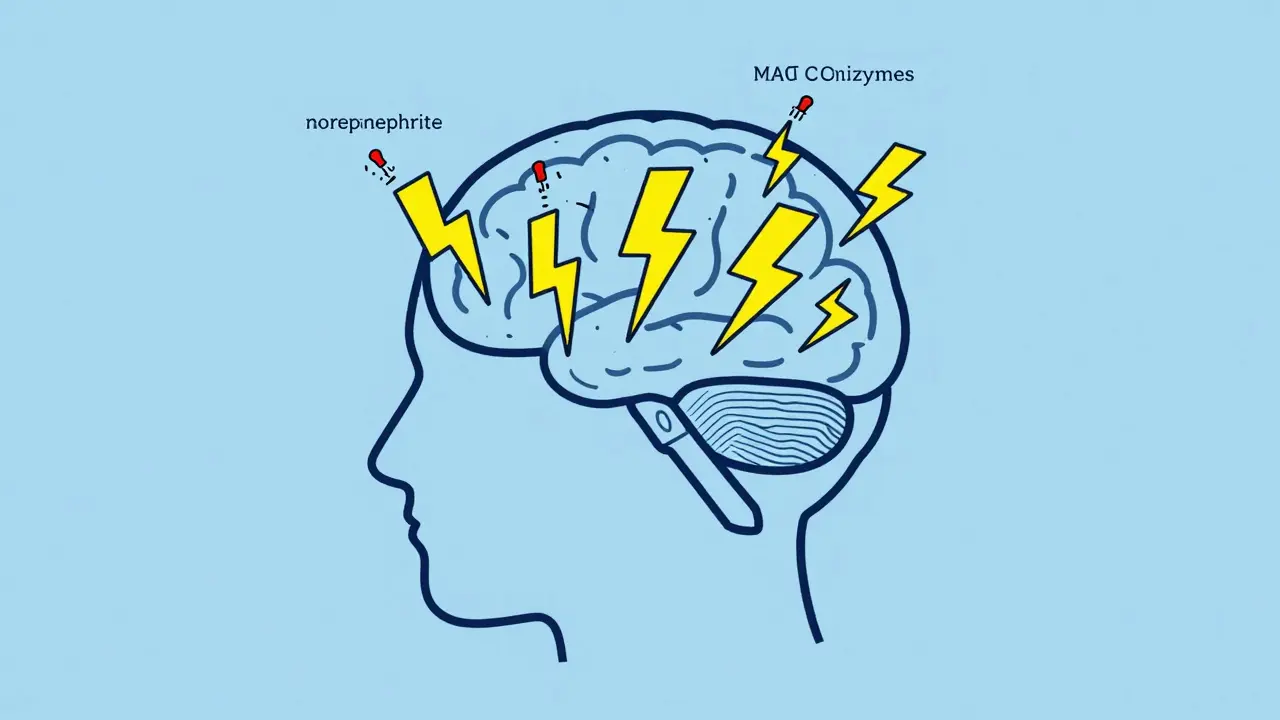
To understand the danger, you have to look at how your brain cleans up its chemicals. Normally, an enzyme called Monoamine Oxidase (specifically the MAO-A subtype) acts like a vacuum cleaner, breaking down excess norepinephrine and tyramine (a compound found in many foods).
MAOIs do exactly what their name says: they inhibit that vacuum cleaner. When you take an MAOI, your levels of norepinephrine stay higher for longer. Now, add an ADHD stimulant like Adderall or Vyvanse into the mix. These drugs force the brain to release even more norepinephrine and block its re-absorption.
Suddenly, you have a "perfect storm." You're pumping out massive amounts of a chemical that tells your blood vessels to tighten (vasoconstriction), and you have no enzyme left to break that chemical down. The result is a massive, rapid surge in blood pressure that your body cannot stop on its own.
Comparing the risk levels: Not all stimulants and MAOIs are equal
While the general rule is "do not mix," the intensity of the risk varies depending on the specific drug. For example, amphetamines are generally more dangerous in this pairing than methylphenidates because they trigger a more aggressive release of norepinephrine.
| Medication Type | Common Examples | Relative Risk | Primary Reason for Risk |
|---|---|---|---|
| Amphetamines | Adderall, Vyvanse | High | Strong noradrenergic effect; direct NE release. |
| Methylphenidates | Ritalin, Concerta | Moderate-High | Primarily dopaminergic; less NE release. |
| Traditional MAOIs | Tranylcypromine, Phenelzine | High | Irreversible enzyme inhibition; strong interaction. |
| Selective MAOIs | Selegiline (Patch) | Lower (at low doses) | Preferential MAO-B inhibition; avoids gut issues. |
| RIMA MAOIs | Moclobemide | Low | Reversible inhibition; effects wear off faster. |
Interestingly, the delivery method matters. The Emsam patch (transdermal selegiline) at doses of 6 mg/24 hours is often seen as a safer bet because it doesn't block the enzymes in your gut as aggressively as a pill would, reducing the risk of "cheese reactions" (hypertensive spikes from eating aged foods).
The "Washout Period": Why you can't just switch overnight
One of the biggest mistakes people make is stopping an MAOI on Monday and starting a stimulant on Tuesday. This doesn't work because MAOIs are often irreversible. They don't just block the enzyme; they destroy it. Your body has to physically manufacture new monoamine oxidase enzymes from scratch before it's safe to introduce a stimulant.
The medical gold standard is a 14-day washout period. You must be completely off the MAOI for two full weeks to allow your enzyme levels to recover. If you jump the gun, you are still essentially taking a stimulant while your body is in an MAOI-like state, which can still trigger a crisis.

When experts break the rules: Cautious combination therapy
You might wonder why some doctors-like those at Massachusetts General Hospital or Johns Hopkins-occasionally combine these drugs. This is usually reserved for "refractory" cases, where a patient has depression that hasn't responded to any other treatment and severe ADHD that makes their life unmanageable.
When they do this, they don't just hand over a prescription. They follow a strict protocol:
- Micro-dosing: They might start a stimulant at only 10% to 25% of the normal dose (e.g., 2.5 mg of dextroamphetamine).
- Active Monitoring: Blood pressure is checked every 15 to 30 minutes during the initial dose increase.
- Home Tracking: Patients are required to use home blood pressure monitors daily.
- Dietary Strictness: Total avoidance of tyramine-rich foods (like aged cheddar, salami, and draft beer) to keep the baseline blood pressure stable.
Even with these precautions, the risk-benefit ratio still favors avoidance. For most people, the danger of a stroke far outweighs the benefit of the combination.
Spotting the danger: Red flags and emergency steps
If you have taken these medications together, or if you started a stimulant too soon after an MAOI, you need to know the warning signs. A hypertensive crisis often starts with a sudden, blinding headache-usually at the back of the head-followed by nausea, vomiting, and chest pain. You might also experience a racing heart (tachycardia) or shortness of breath.
If these symptoms appear, this is a medical emergency. Do not "wait and see" if the headache goes away. Go to the ER immediately and tell the triage nurse exactly which medications you have taken. The doctors need to know about the MAOI specifically so they can use the right blood pressure-lowering agents without making the situation worse.
Can I take a stimulant if I'm on a low-dose Selegiline patch?
While low-dose (6mg/24h) transdermal selegiline has a lower risk profile because it doesn't inhibit enzymes in the gut as much, the FDA still maintains a general contraindication. Any combination should only be done under the direct supervision of a psychiatrist who can monitor your blood pressure in real-time.
How long does it take for the MAOI effect to wear off?
Because most MAOIs bind irreversibly to enzymes, your body needs to grow new ones. This process typically takes about 14 days. This is why the two-week washout period is the standard safety requirement before starting ADHD stimulants.
What foods should I avoid if I'm taking an MAOI?
Avoid tyramine-rich foods. This includes aged cheeses (like brie or swiss), cured meats (salami, pepperoni), fermented soy products (miso, soy sauce), and certain alcohols like tap beers and red wine. Keeping tyramine intake under 50 mg daily is crucial to avoid blood pressure spikes.
Is methylphenidate safer than amphetamine with MAOIs?
Theoretically, yes. Methylphenidate primarily blocks the reuptake of dopamine and norepinephrine, whereas amphetamines actually force the release of these chemicals. This makes amphetamines more likely to cause a massive spike in blood pressure when the breakdown enzyme is missing.
What is a RIMA, and is it safer?
RIMA stands for Reversible Inhibitor of Monoamine A. Unlike traditional MAOIs, RIMAs like moclobemide only temporarily block the enzyme. This means they have a much lower risk of causing a hypertensive crisis and generally don't require the same strict dietary restrictions.

Jon Moss
April 26, 2026 AT 01:02man it's scary how one wrong move with a prescription can lead to something so heavy
Majestic Blue Band
April 26, 2026 AT 20:17It is absolutely fascinating how we are told to follow these 14-day washout periods as if the pharmaceutical companies aren't just fabricating these timelines to keep us dependent on their specific cycling schedules and honestly if you look at the way the FDA pushes these black box warnings it feels more like a psychological operation to keep us in a state of perpetual fear so that we never question why these drugs were developed in the first place or who actually benefits from the terror of a hypertensive crisis which probably isn't the patient at all but the emergency room complexes that profit from the fallout of these interactions
Anand Mehra
April 28, 2026 AT 10:27science is just a series of managed accidents
suresh kumar
April 29, 2026 AT 05:04This whole chemistry dance is a wild rollercoaster ride for the veins
Just imagine the blood pressure skyrocketing like a rocket ship in a storm
Hayley Redemption
April 30, 2026 AT 05:23The simplistic presentation of the risk profiles here is almost quaint. One would expect a more rigorous analysis of the pharmacokinetics involved rather than a basic table for the masses. It is quite obvious that the interaction is non-linear and depends heavily on individual metabolic rates which the author conveniently glosses over for the sake of a general warning.
Gauri Parab
May 1, 2026 AT 13:41Exactly. The idea that methylphenidate is safer is a convenient narrative but it ignores the nuance of individual receptor sensitivity. I find it laughable that people think a 'lower' risk is an 'acceptable' risk when we are talking about aortic dissection. The entire medical approach to these refractory cases is a gamble wrapped in a lab coat.
William Zhigaylo
May 1, 2026 AT 18:02The sheer negligence of anyone who would attempt to bypass a washout period is utterly abhorrent. It is a testament to the decline of intellectual rigor in modern patient care that such a fundamental warning must be reiterated in a public forum. The biological consequences are not merely 'risks'-they are inevitable failures of logic and safety.
Kristen O'Neal
May 2, 2026 AT 06:44I think it's actually really helpful to see the breakdown of RIMAs versus traditional MAOIs here since a lot of people don't even know those exist. It's a great reminder that there are different options if the traditional ones are too risky for someone's lifestyle.