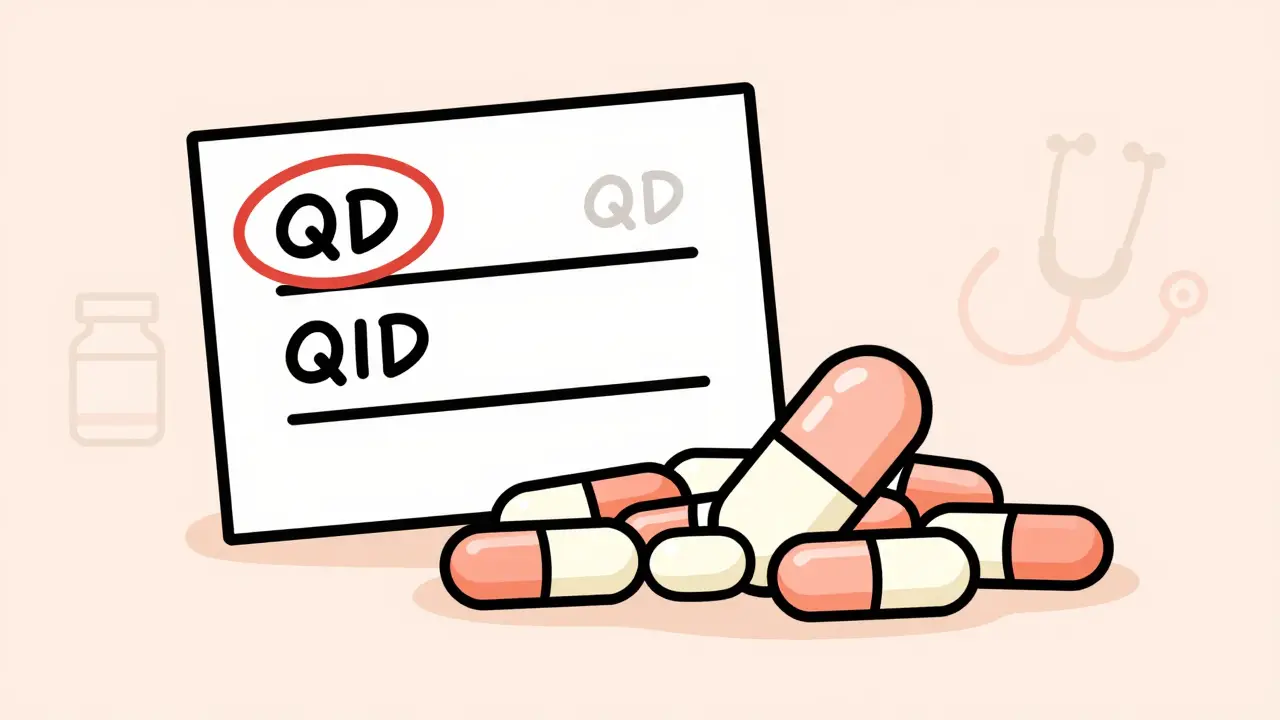
Imagine taking a pill four times a day when your doctor meant once. That’s not a mistake you can afford to make - especially if it’s a blood thinner, a heart medication, or a sedative. This isn’t hypothetical. It happens. And the reason? The confusing abbreviations QD and QID.
What QD and QID Really Mean (And Why They’re Dangerous)
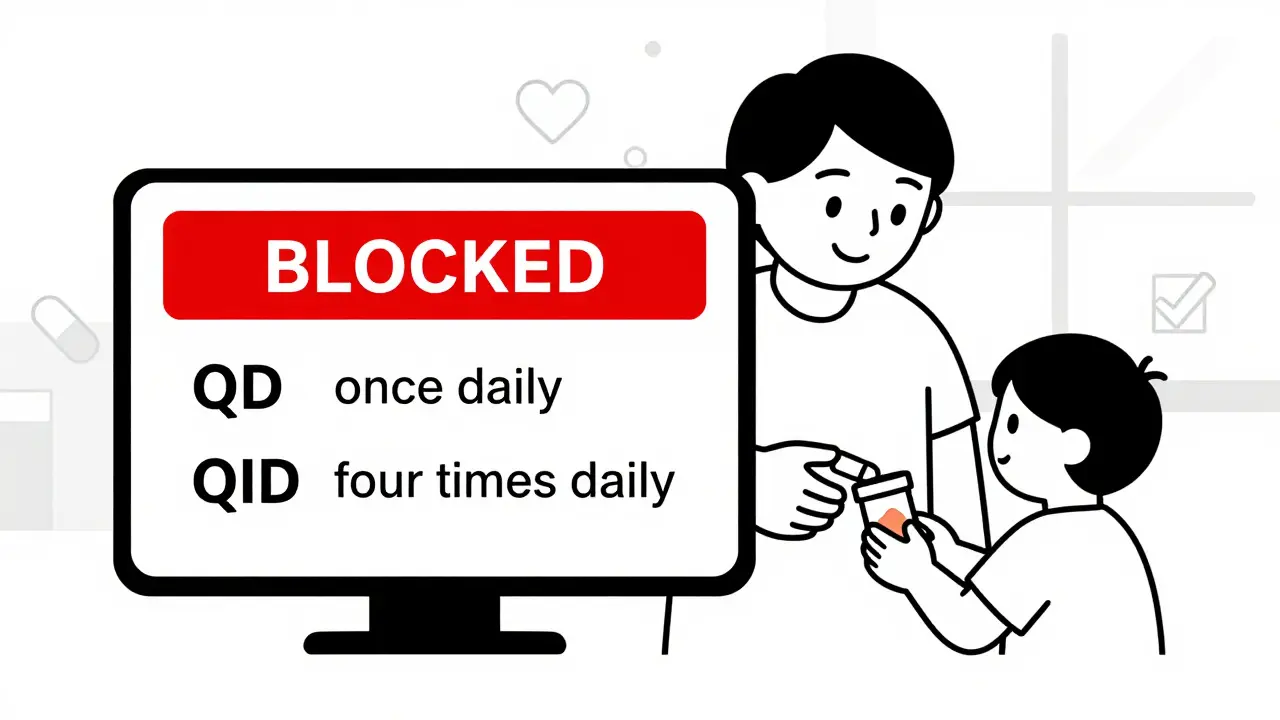
QD stands for quaque die - Latin for "once daily." QID means quater in die - "four times daily." They look similar. One letter changes everything. And in the chaos of a busy clinic, a tired pharmacist, or a handwritten script, that tiny difference can turn a safe dose into a life-threatening one.
The Institute for Safe Medication Practices flagged these abbreviations as high-risk back in 2001. The Joint Commission added them to their "Do Not Use" list in 2004. Yet, over 20 years later, they’re still showing up on prescriptions. Why? Habit. Tradition. And the false belief that everyone "knows" what they mean.
But here’s the truth: people don’t. A 2018 study in the Journal of Patient Safety found that in simulated prescription reviews, 12.7% of healthcare workers misread QD as QID. That’s more than one in eight. For staff with less than five years of experience? The error rate jumped to 18.2%. And it’s not just new staff - even experienced pharmacists and nurses have been caught out.
The Real-World Consequences
These aren’t just numbers. They’re people.
In one documented case, a construction inspector took his blood pressure medication four times daily instead of once. He kept working. He kept driving - with his 7-year-old daughter in the car. He didn’t realize anything was wrong until he went back for a refill and the pharmacist asked, "Why are you taking this so often?" He’d been overdosing for a full week.
Another patient, on warfarin, ended up with an INR of 12.3 - a level that can cause spontaneous bleeding. She was hospitalized. Her life was saved, but barely. The error? A handwritten "1 tab QD" was read as "take four times daily."
These aren’t rare outliers. The American Geriatrics Society found that 68% of documented QD/QID errors involve patients over 65. Older adults are more likely to be on multiple medications, have trouble reading small print, or rely on family members to help manage pills. A simple misread can cascade into a fall, a stroke, or worse.
According to the FDA, about 5% of all medication errors reported to their system are tied to confusing abbreviations - and QD/QID is one of the biggest contributors. The World Health Organization says these kinds of errors lead to 6.5% of all preventable adverse drug events worldwide.
Why Do These Abbreviations Still Exist?
You’d think electronic prescriptions would have killed these off by now. And in many places, they have. But here’s the gap: 31% of community pharmacies still receive handwritten prescriptions using QD and QID - mostly from independent doctors who haven’t switched to electronic systems.
Even in hospitals and clinics with modern EHRs, the problem persists. Some providers still manually type in "QD" instead of selecting "once daily" from a dropdown. And when systems allow it, errors slip through. A 2021 analysis by the Agency for Healthcare Research and Quality found that 3.8% of errors in electronic systems still come from manual overrides of standard dosing options.
Some providers argue that abbreviations save time. But the math doesn’t add up. Writing "daily" takes three more letters than "QD." That’s it. Three letters. Is it really worth risking someone’s life over saving a few seconds?
What’s Being Done to Fix This?
Change is happening - but it’s slow.
In 2023, the American Medical Association updated its prescribing guidelines to require writing out "daily," "twice daily," and "four times daily" - no abbreviations allowed. The FDA followed with draft guidance telling prescribers to avoid Latin terms entirely. Epic and Cerner, the two biggest EHR systems, now have "hard stops" that won’t let you save a prescription if you type "QD" or "QID."
It’s not just technology. Training matters. The University of Michigan Health System found that when pharmacists started verbally confirming dosing instructions with every patient, errors dropped by 67% in just 18 months. That’s not a tech fix - it’s a human one. A simple conversation: "Just to be sure - you’re supposed to take this once a day, right? Not four times?"
Hospitals that eliminated all abbreviations saw a 42% drop in dosing errors within a year. The National Action Alliance for Patient Safety launched the "Clear Communication Campaign" in 2023 with a goal of reducing abbreviation-related errors by 90% by 2026 - backed by $45 million in federal funding.
What You Can Do - As a Patient or Caregiver
You don’t have to wait for the system to fix itself. Here’s what you can do right now:
- Ask for plain language. If you see "QD" or "QID" on your prescription label, ask: "Does this mean once a day or four times a day?" Don’t assume.
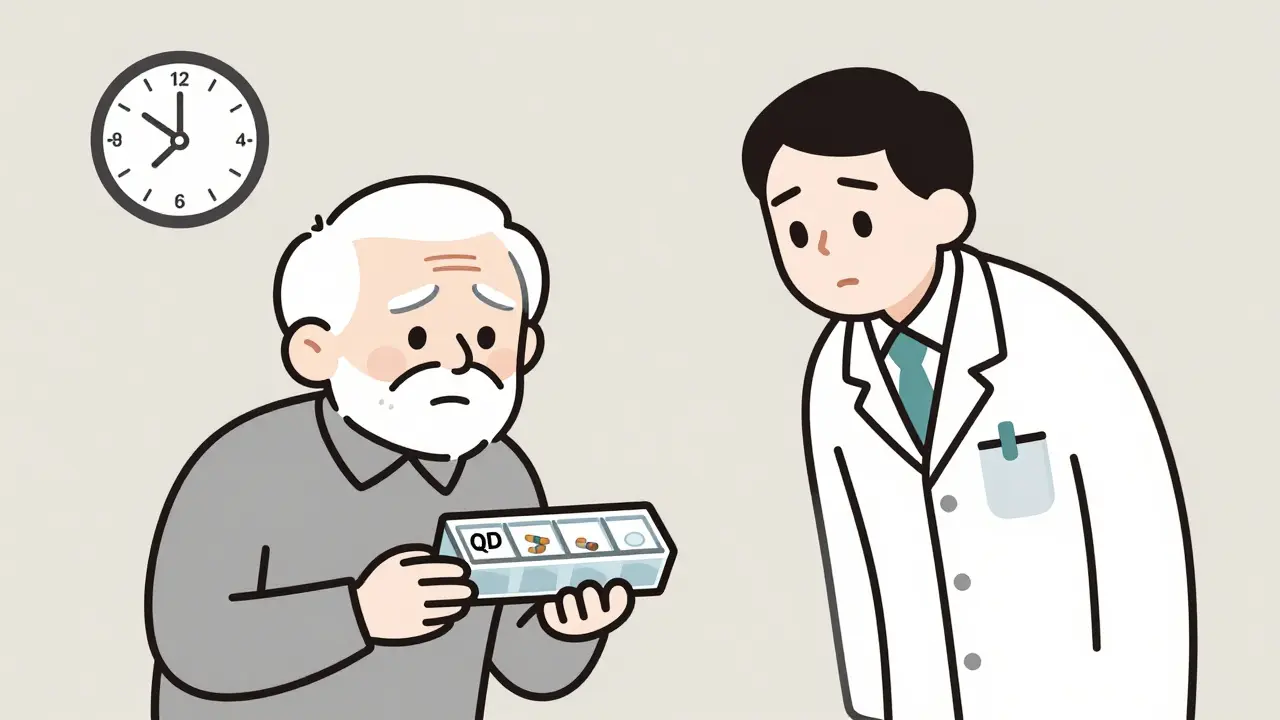
- Use a pill organizer. Label each compartment with the time and purpose. If you’re taking something daily, make sure only one slot has it.
- Check with your pharmacist. Pharmacists are trained to catch these errors. If something feels off - speak up. They’ve seen this before.
- Take a picture. Snap a photo of your prescription label and show it to a family member. Sometimes a fresh pair of eyes catches what you miss.
- Know your meds. If you’re on a blood thinner, diabetes drug, or heart medication, know the correct dose. A mistake here can be deadly.
Why This Matters More Than You Think
Medication errors cost the U.S. healthcare system over $2 billion a year. Of that, $780 million is directly tied to dosing frequency mistakes - and QD/QID confusion is a major part of that. But money isn’t the only cost. Lives are lost. Families are shattered. Trust in the system erodes.
The good news? This is one of the easiest medication safety problems to fix. No new drugs. No complex tech. Just writing out the words.
"Daily" is clearer than QD. "Four times daily" is safer than QID. There’s no downside. Only upside.
Healthcare has come a long way. But until every prescription - handwritten or digital - uses plain language, people will keep getting hurt. And it doesn’t have to be this way.
Final Thought
It’s not about being perfect. It’s about being clear. One extra word can save a life. So if you’re a prescriber - write it out. If you’re a patient - ask. If you’re a pharmacist - verify. This isn’t bureaucracy. It’s basic safety.
What does QD mean on a prescription?
QD stands for "quaque die," which means "once daily." But because it looks similar to QID, it’s often misread as "four times daily," leading to dangerous overdoses. The safest practice is to write "daily" instead.
What does QID mean on a prescription?
QID means "quater in die," or "four times daily." It does not mean every 6 hours. The doses should be spread out during waking hours - for example, morning, midday, afternoon, and evening - not at night while sleeping.
Are QD and QID still used in prescriptions today?
Yes, but they’re being phased out. Most electronic systems now block them, and major medical organizations have banned their use. However, about 31% of community pharmacies still receive handwritten prescriptions with these abbreviations, especially from doctors who haven’t switched to digital systems.
How common are QD/QID errors?
In simulated reviews, QD was misread as QID in 12.7% of cases - making it one of the most common abbreviation errors. Among less experienced staff, the rate rises to 18.2%. These errors have led to hospitalizations, bleeding events, and even deaths.
What’s the safest way to write dosing instructions?
Always use plain language: "once daily," "twice daily," "three times daily," or "four times daily." Avoid all Latin abbreviations like QD, QID, BID, and TID. Writing out the full phrase reduces confusion and improves safety.
Can patients do anything to prevent these errors?
Yes. Always ask your pharmacist to confirm how often to take each medication. If the label says QD or QID, ask for clarification. Use a pill organizer labeled with times and purposes. Take a photo of your prescription and show it to a trusted family member. Never assume - verify.

vivek kumar
January 17, 2026 AT 08:34QD and QID are literally life-or-death typos. I work in a pharmacy in Delhi and we still get handwritten scripts with these all the time. One guy came in for his wife’s blood thinner-QD written like a sloppy QID. He was taking four doses a day for three weeks. His INR was through the roof. We caught it because the script had a smudge. Imagine if we hadn’t. This isn’t about tradition-it’s about laziness disguised as efficiency.
swarnima singh
January 17, 2026 AT 20:28i mean… like… why do we even use latin? it’s not like anyone speaks it anymore. it’s just so… pretentious? like we’re trying to sound smart but we’re just making people die. also i think doctors are scared of writing full words because they’re too busy scrolling tiktok.
Isabella Reid
January 18, 2026 AT 15:31My grandma almost died from this exact thing. She’s 82, takes six meds, and the pharmacist had to call the doctor to confirm if "QD" meant once a day. She didn’t even know what "QD" stood for. We switched to plain language on all her scripts after that. It’s not rocket science. Just write "once daily." It’s not harder. And it saves lives. Why is this still a debate?
Jody Fahrenkrug
January 20, 2026 AT 04:22I’m a nurse in a rural clinic. We still get handwritten scripts with QID all the time. I always read them out loud to the patient before handing over the med. "Is this supposed to be four times a day?" Sometimes they say yes. Sometimes they say no. Sometimes they just nod and leave. We need better systems. But also-we need to talk to people. Not just write on paper.
Kasey Summerer
January 21, 2026 AT 21:58QD vs QID? Bro. It’s like confusing "i" and "l" in a password. Except instead of getting locked out of your email, you get locked out of life. 😅
Allen Davidson
January 23, 2026 AT 04:32This is why I always write out "once daily" in bold, underlined, and circled. I don’t care if it takes 5 extra seconds. My patients aren’t lab rats. I’ve seen what happens when someone takes a beta-blocker four times a day. Their heart nearly stopped. They didn’t even know. And now they’re terrified of all meds. That’s the real cost-not the time saved by typing QD.
john Mccoskey
January 23, 2026 AT 19:27Let’s be honest: this isn’t about abbreviations. It’s about systemic incompetence. The fact that we’re still debating whether to write "daily" instead of "QD" after 20 years of warnings is a symptom of a healthcare system that values convenience over competence. It’s not that providers are ignorant-it’s that they’re indifferent. They’ve been trained to optimize for throughput, not safety. The EHRs block QD? Great. But the ones who still use paper? They’re the ones who don’t care enough to change. And until we punish that indifference, people will keep dying because someone couldn’t be bothered to type six extra characters.
Henry Ip
January 25, 2026 AT 17:08Just started using plain language on all my scripts. No more QD, QID, BID. Took me a week to break the habit. Now I don’t even think about it. My patients thank me. My pharmacist thanks me. My conscience thanks me. Simple fix. Why aren’t we all doing this?
waneta rozwan
January 26, 2026 AT 10:23THIS IS WHY WE CAN’T HAVE NICE THINGS. Someone’s going to die because a doctor was too lazy to write "once daily" and now we’re all paying for it with our trust in the system. And guess what? The same people who write QD are the ones who complain about lawsuits. Well guess what? You created the lawsuit. You wrote the mistake. You didn’t care enough to be clear. Now the family has to bury someone. And you’re still typing QID like it’s 1999.
Chelsea Harton
January 28, 2026 AT 07:36qid means 4x a day. qd means once. if you mix them up you’re basically playing russian roulette with your meds. just write it out. it’s not hard.
Travis Craw
January 28, 2026 AT 08:34i work at a pharmacy and we get these all the time. i just call the doc and ask. they’re usually like oh whoops. but what if we didn’t have to? why is this still a thing? i mean… it’s just three letters. why not write it out?