Naloxone Co-Prescribing Risk Calculator
Opioid Overdose Risk Assessment
This tool helps determine if naloxone co-prescribing is recommended based on CDC guidelines.
Patient Risk Factors
Risk Assessment Result
Every year, thousands of people in the U.S. die from opioid overdoses-not because they were using drugs illegally, but because they were taking prescribed pain medication. For many, the risk isn’t obvious. They’re following their doctor’s orders, managing chronic pain, and never imagined a simple pill could become deadly. That’s where naloxone co-prescribing comes in: a simple, life-saving step that’s now becoming standard care for patients on opioids.
What Is Naloxone Co-Prescribing?
Naloxone co-prescribing means giving a patient naloxone at the same time they receive an opioid prescription. Naloxone isn’t a painkiller. It’s an overdose reversal drug. When someone overdoses on opioids, their breathing slows or stops. Naloxone works fast-it pushes the opioids off the brain’s receptors and brings breathing back within minutes. It’s safe, non-addictive, and has no effect if opioids aren’t in the system.
This isn’t a new idea. The CDC first recommended it in 2016. Since then, it’s been backed by the American Medical Association, the Department of Health and Human Services, and even the World Health Organization. The goal? Make sure that if an overdose happens-whether by accident, mistake, or relapse-someone nearby can act before it’s too late.
Who Needs Naloxone With Their Opioid Prescription?
Not every patient on opioids needs naloxone. But many do. The CDC says you should offer it when any of these risk factors are present:
- Taking 50 morphine milligram equivalents (MME) or more per day
- Using benzodiazepines (like Xanax or Valium) at the same time
- Having a past overdose or substance use disorder
- Having COPD, sleep apnea, or other breathing problems
- Using alcohol heavily or having depression, anxiety, or other mental health conditions
- Recently been released from jail or prison
Why these? Because they make overdose more likely. Mixing opioids with benzodiazepines doubles the risk. High doses? A person on 90 MME/day has over twice the overdose risk of someone on 20 MME. And after jail? Tolerance drops fast. Someone who used to take opioids daily might not be able to handle the same dose anymore-and that’s when overdose hits hardest.
How Does Naloxone Work?
Naloxone is like a key that fits better into opioid receptors than the opioid itself. When you give it during an overdose, it kicks the opioid out and lets oxygen flow again. It doesn’t cause euphoria. It doesn’t make you high. It doesn’t cure addiction. It just gives you time.
There are two main forms used today:
- Intranasal spray (like Narcan® or Kloxxado™): Easy to use. No needle. Just spray into one nostril. Most patients and families prefer this.
- Injectable: Used in hospitals or by trained responders. Requires a syringe and injection into the arm or thigh.
Dosing is simple: 2 to 4 mg per dose. If there’s no response after 2-3 minutes, give a second dose. The spray lasts 30-90 minutes, but opioids can last longer. That’s why you must call 911 even after giving naloxone.
Real Impact: Numbers Don’t Lie
Studies show this works. In a 2019 study of nearly 2,000 patients, those who got naloxone with their opioid prescription had 47% fewer emergency room visits and 63% fewer hospital stays due to overdose. In rural Kentucky, one clinic documented 17 overdose reversals in two years-each one saved by a family member using the naloxone kit they were given.
At the national level, naloxone distribution has grown fast. From 2017 to 2018, prescriptions for naloxone jumped 114%. After the SUPPORT Act passed in 2018, Medicare and Medicaid started covering it with little to no copay. Generic versions hit the market in 2022, and prices dropped from $130 to under $50 per kit. Now, more pharmacies stock it-and more patients get it.
Why Some Patients Refuse It
Not everyone accepts it. In a 2021 survey, 68% of doctors said patients push back. Why? Stigma. Some think, “If you’re giving me naloxone, you think I’m going to overdose.” Others feel judged. A Reddit post from a physician assistant said 60% of their patients refuse.
But stories change minds. Sarah Johnson, a chronic pain patient in Ohio, was offended when her doctor offered naloxone with her oxycodone. Then her 16-year-old son found the pills and took them. He stopped breathing. Sarah used the nasal spray. He woke up. She later said, “That spray saved his life. Now I carry two.”
Family members feel safer too. A 2022 survey found 78% of caregivers felt more secure knowing naloxone was available. The problem? Only 38% of high-risk patients actually receive it-even though guidelines say they should.
How Clinicians Can Make It Work
Doctors aren’t always sure how to bring it up. Here’s how to do it right:
- Assess risk: Use your state’s Prescription Drug Monitoring Program (PDMP) to check opioid doses and other prescriptions. Look for benzodiazepines, past overdoses, or mental health diagnoses.
- Explain plainly: Don’t say, “You might overdose.” Say, “This is like a seatbelt. You hope you never need it, but if something happens, it helps.”
- Teach how to use it: Use the S.L.A.M. method: Signs of overdose (unresponsive, slow breathing, blue lips), Life-saving steps (call 911, check breathing), Address naloxone (spray or inject), Monitor until help arrives.
- Include family: Give instructions to spouses, kids, or roommates. Many overdoses happen at home.
Electronic health records (EHRs) now have templates for this. Sixty-three percent of large health systems use them. Standing orders in 49 states let pharmacists dispense naloxone without a new prescription-so even if the doctor forgets, the pharmacy can step in.
State Laws Are Changing Fast
As of 2024, 24 states require doctors to offer naloxone with opioid prescriptions. But the rules vary:
- New York: Offer naloxone to anyone getting an opioid prescription.
- California: Only if the dose is over 90 MME/day.
- Most states: Follow the CDC’s 50 MME/day rule.
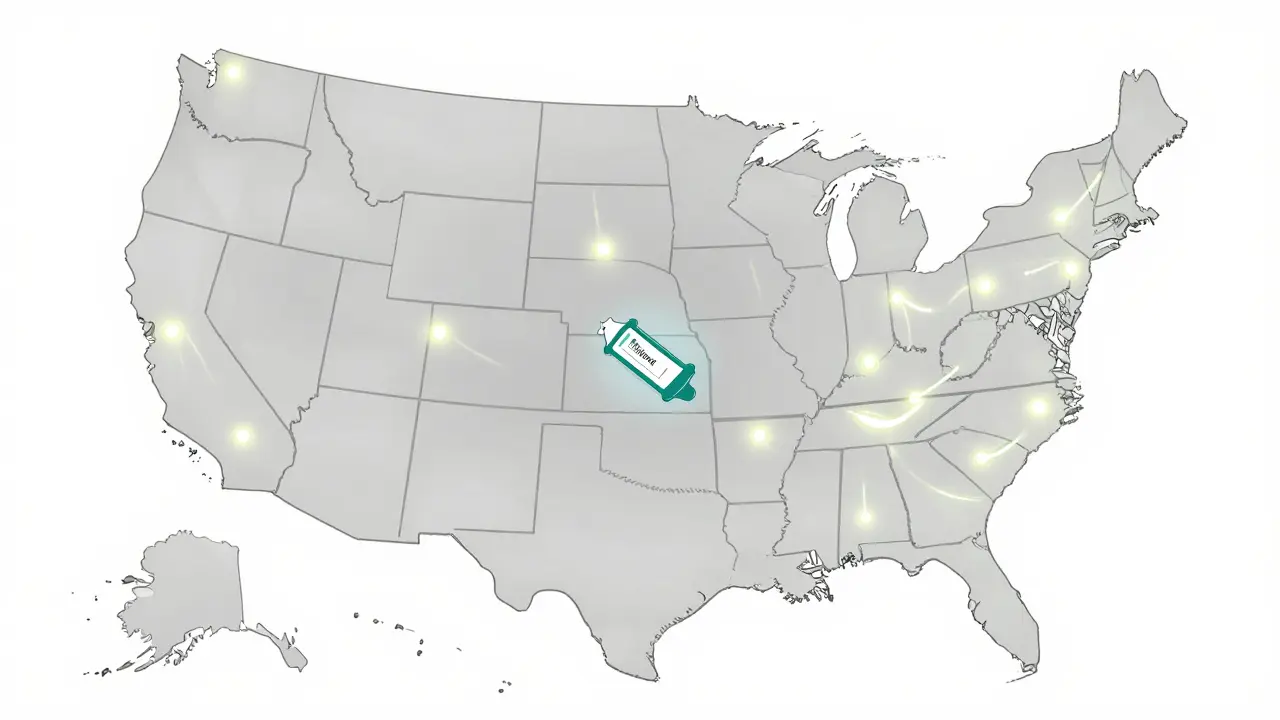
Some states still don’t require it. That’s why access is uneven. Urban pharmacies stock naloxone 85% of the time. Rural ones? Only 42%. That gap kills.
What’s Next?
The federal government is doubling down. In 2023, HHS gave $100 million to distribute 1.2 million naloxone kits to community groups. The FDA approved the first generic nasal spray in April 2023, cutting costs further. A long-acting naloxone formulation is in Phase III trials-could last 48 hours instead of 90 minutes.
But the biggest barrier isn’t science. It’s habit. Doctors still hesitate. Patients still feel shame. Pharmacies still run out. We need more training, more funding, and more honest conversations.
Overdose isn’t always about addiction. Sometimes, it’s about a missed dose, a bad mix, or a child finding pills. Naloxone co-prescribing doesn’t mean giving up on pain management. It means being smart about it. It means saying, “I care enough to prepare for the worst.”
For patients on opioids, naloxone isn’t a sign of failure. It’s a safety net. And everyone deserves one.
trudale hampton
March 21, 2026 AT 00:38Naloxone co-prescribing is one of those ideas that seems so obvious once you hear it-like seatbelts or smoke detectors. Why wouldn’t you give someone a way to survive if things go sideways? I’ve seen too many stories where families didn’t know what to do until it was too late. This isn’t about judging people-it’s about giving them a fighting chance.
And honestly? The fact that pharmacies can dispense it without a new script is a game-changer. No more waiting for a doctor’s appointment when time matters.
Still, we need better public education. Most people think naloxone is only for drug addicts. It’s not. It’s for anyone on opioids-even grandma taking her pain meds after knee surgery.
Shaun Wakashige
March 21, 2026 AT 16:41lol just give em the spray and call it a day 😂
Sandy Wells
March 21, 2026 AT 20:43So now we’re treating chronic pain patients like they’re ticking time bombs? This feels like punishment disguised as care. If someone’s taking their meds as prescribed why should they be handed a drug that implies they’re going to OD? It’s demeaning. And don’t get me started on how this pushes the narrative that all opioid users are addicts.
Just because something works doesn’t mean it’s right to force it on people. There’s a better way than stigma wrapped in a nasal spray.
Bryan Woody
March 22, 2026 AT 21:06Let me guess-the same people who think naloxone is ‘enabling’ are the ones who also think seatbelts encourage reckless driving? Nah. Naloxone doesn’t encourage overdose. It prevents death. Period. You’re not ‘enabling’ someone by giving them a fire extinguisher. You’re just being responsible.
And yeah I know 68% of docs say patients push back. Guess what? That’s because they say it wrong. ‘We’re giving you this because we care’ doesn’t work. Say ‘this is insurance against a mistake’-like an airbag. People get that. They don’t need a lecture. They need clarity.
Also-generic naloxone is under $50 now. That’s cheaper than a month’s supply of ibuprofen. If you’re still not stocking it, you’re not trying.
And yes I’ve trained 12 families this year. Every single one of them said they didn’t think they’d ever use it. Then they did. And their kid woke up. So shut up and stock the damn spray.
Chris Dwyer
March 24, 2026 AT 18:47Biggest win here? The fact that caregivers feel safer. That’s huge. Imagine being a parent and knowing your kid’s pain meds aren’t just a risk-they’ve got a backup plan. That peace of mind? Priceless.
And the story about Sarah and her son? That’s why we do this. Not for stats. Not for policy. For moments like that.
Doctors, if you’re hesitating because you think patients will be offended-just say it like you mean it. ‘I care about you too much to not prepare for the worst.’ That’s not judgment. That’s love in action.
And to the folks who say ‘this isn’t my job’-you’re not just prescribing pain meds. You’re managing risk. Full stop. This is part of the job now. Like checking blood pressure before a script. It’s not optional anymore.
matthew runcie
March 26, 2026 AT 16:18Interesting read. Makes me wonder how many lives could’ve been saved if this was standard 10 years ago.
Also glad to see pharmacies stepping up. Even in small towns now you can grab a kit off the shelf without a prescription. That’s progress.
shannon kozee
March 28, 2026 AT 10:42My mom was on opioids after surgery. They gave her naloxone. She cried. Said she felt like they thought she’d OD.
Then her friend’s grandson took a wrong pill. Used the spray. Kid’s fine.
Now she carries two.
It’s not about trust. It’s about safety.
Paul Cuccurullo
March 28, 2026 AT 22:49This is the most beautiful example of compassion in modern medicine I’ve ever seen. To think that a simple, non-addictive, life-saving tool could be so controversial… it breaks my heart.
We are a society that fears death more than we value life. And yet here we are-offering a literal second chance. Not to the ‘addicts.’ Not to the ‘criminals.’ But to mothers. Fathers. Teenagers. Grandparents. People who just wanted relief.
Let this be the moment we stop treating medicine like a moral test. Let it be the moment we start treating it like a human right.
Solomon Kindie
March 29, 2026 AT 20:01So naloxone is the solution to a problem created by pharmaceutical companies and lazy doctors who overprescribed? Interesting. So we’re not fixing the root cause we’re just handing out band aids while the house burns down. Also why are we not talking about why so many people are on opioids in the first place? Chronic pain is often caused by systemic failures in healthcare access and worker exploitation. This is like giving people parachutes while they’re still being pushed out of the plane.
Also why do we keep calling it ‘co-prescribing’? Sounds like a corporate buzzword. Shouldn’t we just call it ‘standard safety protocol’? Because that’s what it is.
Natali Shevchenko
March 31, 2026 AT 17:06There’s something deeply human about this. We don’t just want people to survive-we want them to have dignity while they do. Naloxone doesn’t just reverse overdoses. It reverses shame. It says, ‘You are worth saving, even if you made a mistake.’
I’ve sat with people who’ve lost siblings to overdoses. They never imagined their loved one would be the one. It’s never the dramatic addict. It’s the quiet one. The one who took the pill for back pain and didn’t know mixing it with sleep meds could kill them.
That’s why this matters. Not because of statistics. Not because of policy. But because every life is a story. And we owe it to each other to make sure those stories don’t end too soon.
Also-the fact that 78% of caregivers feel safer? That’s the quiet revolution right there. It’s not about fixing addicts. It’s about healing families.
Johny Prayogi
April 1, 2026 AT 12:37Just got my first naloxone kit today at the pharmacy 🙌 no prescription needed and the pharmacist gave me a hug. I’m keeping it in my car now. If I ever need it, I’ll use it. If someone else needs it, I’ll use it for them too. This is the kind of change we can all be part of. No politics. Just humanity.
Nicole James
April 3, 2026 AT 11:32Wait… so we’re giving out overdose antidotes to people on painkillers… but we’re not investigating why the FDA allowed these drugs to be approved in the first place? And why did Purdue Pharma get away with lying for decades? And why are we still letting insurance companies deny physical therapy? This is just a band-aid on a hemorrhage. They’re using this to make us feel better while the real culprits walk free. Naloxone is a distraction. A PR move. A way to say ‘look how responsible we are’ while the system stays broken.
And don’t get me started on how they market it like a miracle cure. It’s not. It’s a temporary fix. A chemical stopgap. And they know it. They’re counting on us to think we’ve ‘solved’ it. We haven’t. We’ve just made it look like we did.
Nishan Basnet
April 3, 2026 AT 14:47As someone from a country where pain management is still stigmatized and naloxone is unheard of, I find this deeply moving. In my community, people die quietly-no one knows what to do. No one has the tools. No one dares speak up.
What you’re doing here isn’t just medical policy. It’s cultural healing. It says: your life matters. Even if you’re in pain. Even if you’re scared. Even if you made a mistake.
I hope this model spreads. Not just in the US-but everywhere. Because compassion shouldn’t be a privilege. It should be standard.