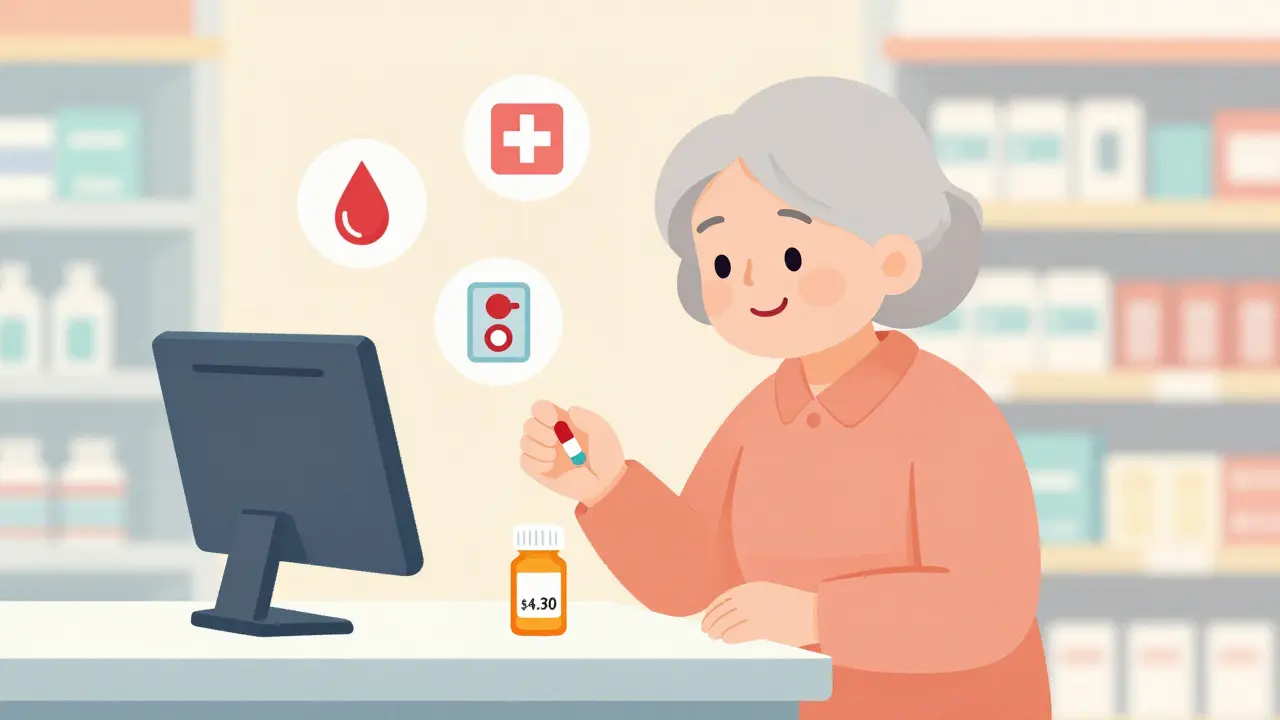
For millions of Medicare beneficiaries, filling a prescription shouldn’t mean choosing between medicine and groceries. Medicare Extra Help is a federal program designed to make generic prescriptions nearly free for those with limited income. If you’re taking one or more daily medications - like blood pressure pills, diabetes drugs, or cholesterol meds - this program can cut your out-of-pocket costs from hundreds of dollars a year to under $700. But many people don’t know they qualify, or they miss the deadlines and lose the benefit. Here’s exactly how it works, what you pay, and how to keep it.
What Medicare Extra Help Actually Covers
Medicare Extra Help, also called the Part D Low-Income Subsidy (LIS), isn’t just a discount. It removes the biggest financial barriers to prescription drugs. If you qualify, you pay:
- $0 for your Part D plan premium
- $0 for your deductible
- Up to $4.90 for each generic drug
- Up to $12.15 for each brand-name drug
That’s it. No hidden fees. No surprise bills. No waiting until you hit a coverage gap. The program covers all these costs automatically. For someone taking 12 generic prescriptions a month, that’s a savings of over $700 a year compared to standard Part D plans. And if you’re also on Medicaid, your copay drops even lower - just $1.60 per generic.
Extra Help doesn’t just lower costs - it removes uncertainty. Without it, you might pay 25% of the drug’s price after meeting a $595 deductible. A $50 generic could cost you $12.50. With Extra Help? You pay $4.90. Always. No matter how many refills you need.
Who Qualifies in 2025
Eligibility is based on two things: income and resources. The limits are strict, but they’re not impossible to meet.
Income limits (2025):
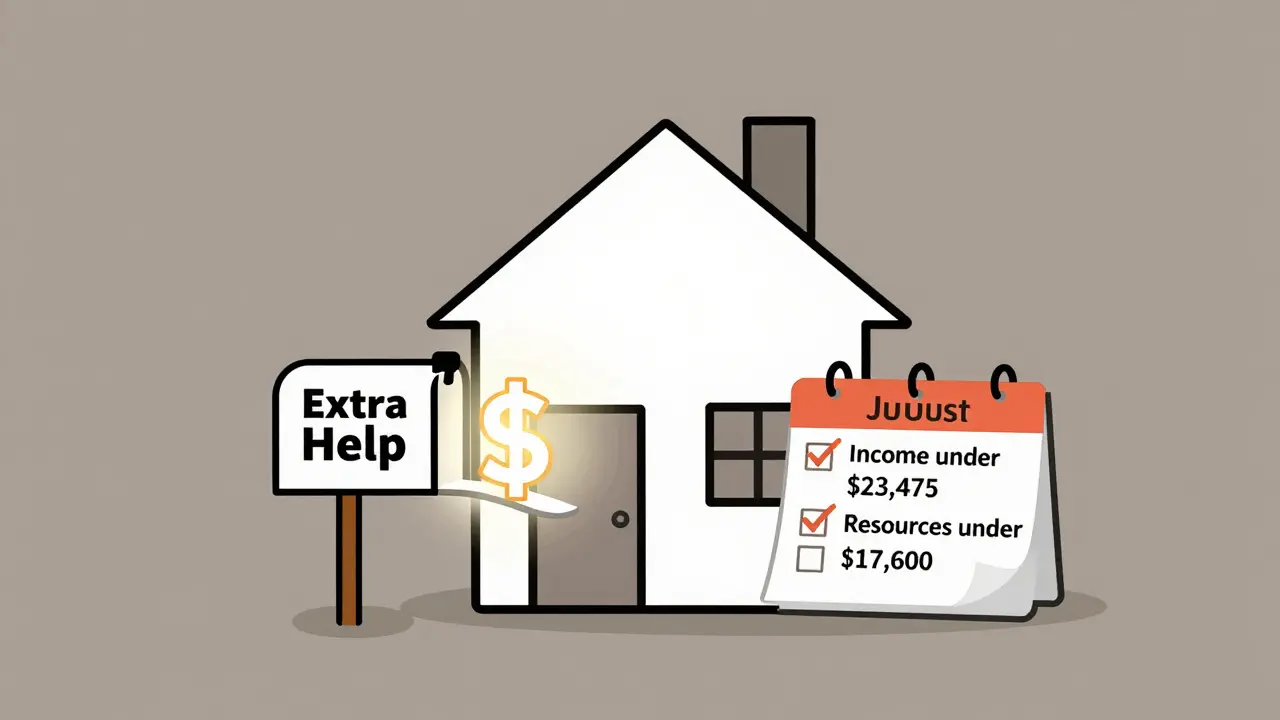
- Individual: $23,475 per year
- Married couple living together: $31,725 per year
This includes Social Security, pensions, wages, veterans’ benefits, and other income. But it doesn’t include housing assistance, food stamps, or medical treatment payments.
Resource limits (2025):
- Individual: $17,600
- Married couple: $35,130
Resources include bank accounts, stocks, bonds, mutual funds, IRAs, and real estate (other than your primary home). You can also have up to $1,500 set aside for burial expenses without it counting against your limit.
Many people think they make too much - but they don’t realize that Social Security income is counted differently than a paycheck. If you’re only on Social Security and live alone, you can earn up to $23,475 and still qualify. That’s more than most people assume.
How Extra Help Compares to Standard Part D
Without Extra Help, here’s what you’re paying in 2025:
- Deductible: up to $595 (you pay this before coverage starts)
- Copay for generics: 25% of the drug’s cost after deductible
- Monthly premium: averages $35-$50
Let’s say you take four generic drugs a month, each costing $40. Here’s the difference:
| Cost Type | Standard Part D (No Extra Help) | With Extra Help |
|---|---|---|
| Monthly drug cost (4 x $40) | $1,920 | $1,920 |
| Deductible | $595 | $0 |
| Coinsurance (25% after deductible) | $331 | $0 |
| Monthly premium | $420 | $0 |
| Generic copays (48 refills x $4.90) | $0 | $235 |
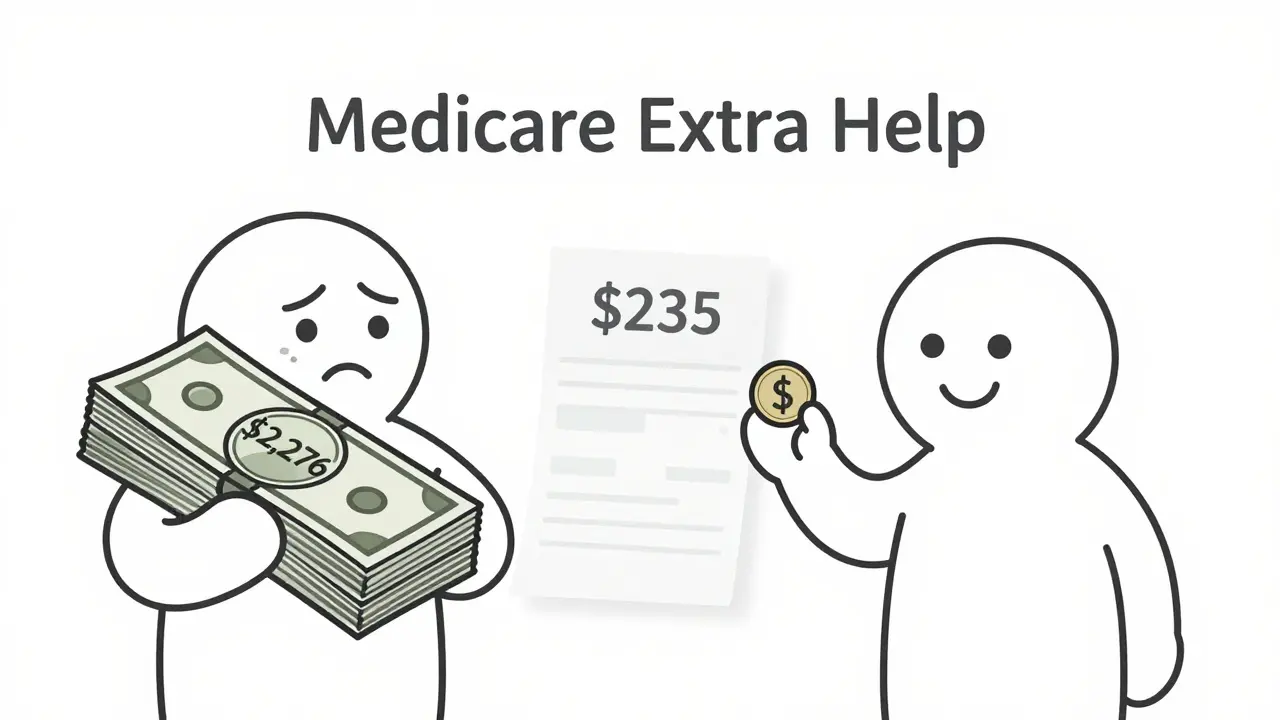
| Total Annual Cost | $2,276 | $235 |
That’s not a typo. One person pays over $2,200. The other pays $235. That’s a 90% savings. And this is for just four drugs. Add more, and the gap widens.
How to Apply (And Avoid Common Mistakes)
You don’t have to be a financial expert to apply. Here’s how:
- Go to ssa.gov and click “Apply for Extra Help.”
- Or call Social Security at 1-800-772-1213 (TTY: 1-800-325-0778).
- Or visit your local Social Security office.
If you already get Supplemental Security Income (SSI), Medicaid, or a Medicare Savings Program, you’re automatically enrolled. No paperwork needed.
Most people take 3 to 6 weeks to get approved. Once approved, the benefit kicks in immediately. You can start using it at any pharmacy that accepts Medicare.
But here’s where people mess up:
- Missing the annual review. Every August, you’ll get a form in the mail. You must return it within 30 days. If you don’t, your Extra Help stops on January 1.
- Thinking a small raise disqualifies you. If your income goes up by $500, you don’t lose everything overnight - but you might lose it if you don’t report it. The system checks your income every year, not every month.
- Not asking for help. State Health Insurance Assistance Programs (SHIPs) offer free one-on-one help. They’ve helped over 70% of applicants get approved. Find yours at shiptacenter.org.
What to Do If You’re Denied or Lose Benefits
It’s not uncommon to be denied - especially if you didn’t list all your income or misunderstood what counts as a “resource.”
If you’re denied:
- Request a written explanation. You have 60 days to appeal.
- Ask your local SHIP counselor to review your application. They often spot errors you missed.
- Check if you qualify for a Medicare Savings Program instead - these can help with premiums and may lead to automatic Extra Help enrollment.
If you lost Extra Help because your income went up - even by a little - you might still qualify for a partial subsidy. Call 1-800-MEDICARE (1-800-633-4227) and ask about “partial Extra Help.” You could still pay as little as $10 per generic instead of $40.
Real Stories: What Happens When People Get (or Lose) Extra Help
One woman in Ohio, age 78, was skipping her diabetes medication because each refill cost $38. She applied for Extra Help after her neighbor told her about it. The next month, her copay dropped to $4.90. She filled every prescription. Her A1C dropped from 9.2 to 6.8 in six months.
A man in Florida, age 72, made $1,000 over the income limit because his Social Security increased slightly. He didn’t report it. When his Extra Help was cut, his monthly drug bill jumped from $60 to $748. He couldn’t afford his heart meds. He spent three months trying to appeal - and eventually got it reinstated after his local AARP office stepped in.
These aren’t rare cases. In 2024, 37% of eligible people weren’t enrolled. Most didn’t know they qualified. Others were afraid to apply because they thought they made “too much.”
What’s Changing in 2025 and Beyond
The Inflation Reduction Act has already capped insulin at $35 a month for all Medicare beneficiaries - including those with Extra Help. That’s a bonus on top of the $1.60-$4.90 you’re already paying.
The Biden administration is pushing to expand Extra Help to people with incomes up to 175% of the Federal Poverty Level - that’s about $28,500 for a single person. If passed, over a million more seniors could qualify.
But even without changes, the program is working. Medicare recipients with Extra Help take their medications 23% more often than those without it. That means fewer hospital stays, fewer ER visits, and better health outcomes.
Final Checklist: Are You Getting the Most Out of Extra Help?
Before you close this page, ask yourself:
- Do I take two or more generic medications every month?
- Is my total income (including Social Security) under $23,475 (or $31,725 if married)?
- Do I have more than $17,600 in savings, stocks, or other assets (excluding my home)?
- Did I get a form from Social Security in August? Did I return it?
- Have I checked if my pharmacy is in my Part D plan’s network?
If you answered yes to the first two, you probably qualify. If you answered yes to any of the last three, you might be missing out.
Don’t wait. Apply now. You won’t regret it.
Do I have to reapply for Extra Help every year?
No, you don’t reapply, but you must complete an annual review. Every August, you’ll get a form from Social Security asking you to confirm your income and resources. You have 30 days to return it. If you don’t, your Extra Help stops on January 1. Many people lose it just because they ignored the letter.
Can I still get Extra Help if I have savings in the bank?
Yes, as long as your total countable resources are under $17,600 (individual) or $35,130 (couple). Your primary home, one car, and up to $1,500 for burial expenses don’t count. But bank accounts, stocks, bonds, and IRAs do. If you’re unsure, call 1-800-MEDICARE or visit your local SHIP office - they’ll help you calculate it.
What if my income goes up next year? Will I lose Extra Help immediately?
No. Extra Help is reviewed once a year, in August. Even if your income increases during the year, you keep your benefits until the next review. You only lose it if you’re found to be over the limit during that annual check. But you must report changes - if you don’t, you could be overpaid and owe money back.
Can I switch my Part D plan if I have Extra Help?
Yes - and you can do it once every month. Most people with Extra Help have a Special Enrollment Period (SEP), which lets them change plans anytime. This is useful if your medications change, your pharmacy closes, or you find a plan with lower copays. Just make sure the new plan covers all your drugs.
Do I need to enroll in a Part D plan to get Extra Help?
Yes. Extra Help doesn’t pay for drugs on its own - it helps you pay for a Part D plan. You must be enrolled in a Medicare Part D prescription drug plan (either through a standalone plan or a Medicare Advantage plan with drug coverage). Extra Help just reduces your costs within that plan. If you’re not enrolled in Part D, you won’t get the subsidy.

Justin Archuletta
March 18, 2026 AT 22:22Kal Lambert
March 20, 2026 AT 13:28Melissa Starks
March 21, 2026 AT 06:11Kyle Young
March 22, 2026 AT 04:00Ayan Khan
March 23, 2026 AT 23:05Emily Hager
March 25, 2026 AT 11:01Lauren Volpi
March 26, 2026 AT 18:57Alexander Pitt
March 28, 2026 AT 04:17Manish Singh
March 28, 2026 AT 12:45Melissa Stansbury
March 29, 2026 AT 10:51Suchi G.
March 30, 2026 AT 01:28Jeremy Van Veelen
March 31, 2026 AT 03:26cara s
March 31, 2026 AT 12:24Shameer Ahammad
March 31, 2026 AT 21:06