
When a hospital decides which drugs to stock, it’s not just about what’s on the market-it’s about what works, what’s safe, and what won’t break the budget. The hospital formulary is the living list of medications approved for use inside a healthcare facility, and its decisions are made by a Pharmacy and Therapeutics (P&T) committee. This isn’t a group of buyers haggling over price tags. It’s a team of pharmacists, physicians, and nurses who weigh clinical data, patient outcomes, and hard-dollar costs every single day. And when it comes to generic drugs, their selection is where hospital economics get real.
What Is a Hospital Formulary, Really?
A hospital formulary isn’t a static catalog. It’s a dynamic, evolving system updated quarterly-or even monthly-based on new evidence, supply issues, and cost shifts. Unlike retail pharmacies, which focus on outpatient convenience, hospital formularies are built for controlled environments: IV drips in ICUs, injections administered by nurses, and pills given under supervision. That changes everything.
The modern formulary typically includes between 300 and 1,000 drug dosage forms. Most hospitals use a closed or partially closed model, meaning only approved drugs can be prescribed unless there’s a documented medical exception. About 78% of academic medical centers operate this way, compared to just 42% of commercial health plans. Why? Because hospitals need control. Unchecked prescribing leads to waste, errors, and runaway costs.
The P&T committee doesn’t just approve drugs-it governs how they’re used. They set quantity limits, require prior authorizations, and enforce step therapy. For example, if a patient needs an antihypertensive, the formulary might require trying a generic first before allowing a brand-name alternative. This isn’t about saving pennies; it’s about managing risk at scale.
How Generics Make the Cut: Beyond FDA Approval
Just because a generic is FDA-approved doesn’t mean it gets into the formulary. That’s a common myth. The FDA says it’s bioequivalent. The P&T committee asks: Is it clinically equivalent?
Generics must prove three things:
- Efficacy: Does it work as well as the brand? Not just in trials, but in real hospital settings-with critically ill patients, complex drug interactions, and varying organ function.
- Safety: Are there differences in inactive ingredients that affect absorption? For drugs with narrow therapeutic indices-like warfarin, lithium, or phenytoin-even small variations can cause toxicity or treatment failure.
- Clinical impact: Will switching to this generic increase nursing workload, require more lab monitoring, or lead to readmissions?
Take anticoagulants. A 2022 case from Johns Hopkins showed that switching from brand to generic warfarin led to unexpected INR fluctuations. Nurses had to check blood levels more often, offsetting the cost savings. The committee pulled the generic off the formulary until they could implement a monitoring protocol.
Complex generics-like inhalers, injectables, or topical creams-are even trickier. The FDA’s own data shows only 62% of complex generic applications are approved on the first try, compared to 88% for simple pills. Hospitals can’t afford to gamble on drugs that might not work consistently.
The Tiered System: How Hospitals Rank Drugs
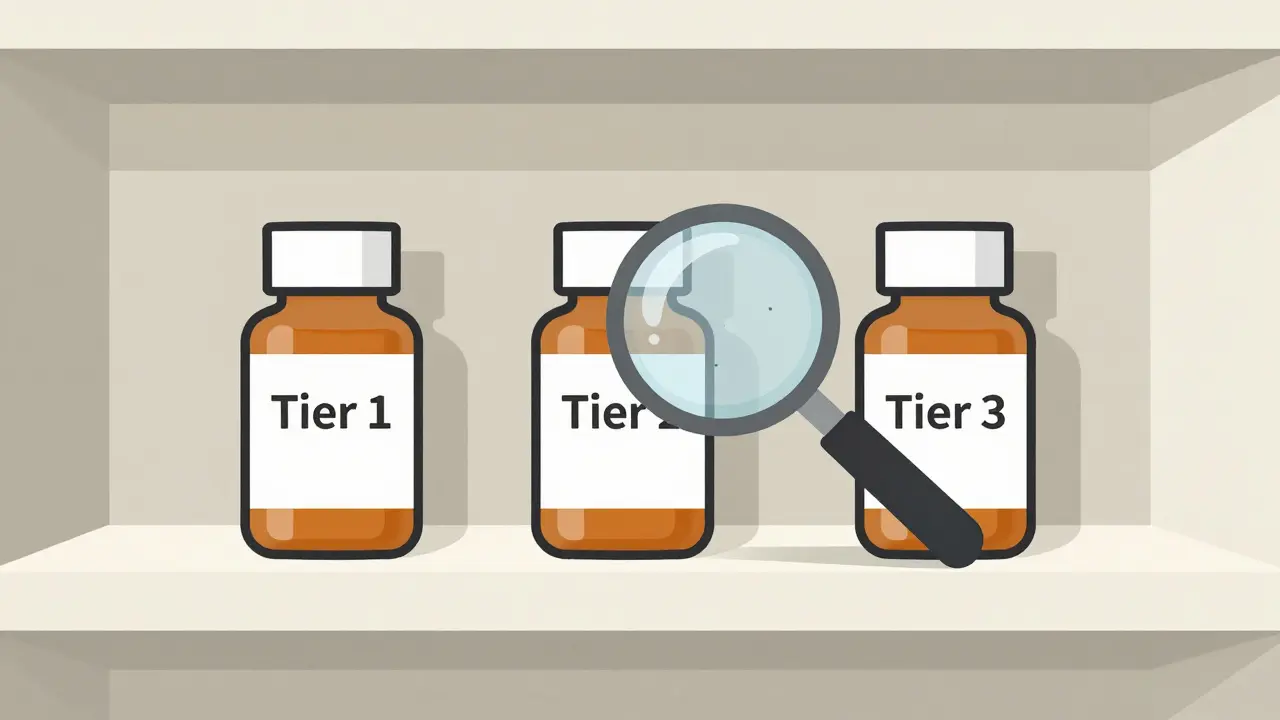
Hospitals don’t just say “yes” or “no.” They tier their formularies to guide prescribing and patient cost-sharing. A typical five-tier system looks like this:
- Tier 1: Preferred generics. Lowest out-of-pocket cost. Often the default choice.
- Tier 2: Non-preferred generics or preferred brands. Moderate cost-sharing.
- Tier 3: Non-preferred brands. Higher cost-sharing. Requires prior authorization.
- Tier 4: Specialty brand drugs. High coinsurance (e.g., 30-40%).
- Tier 5: Ultra-specialty drugs. Often percentage-based cost-sharing with maximum out-of-pocket caps.
Generics dominate Tier 1. But not all generics are created equal. A hospital might have five different generic versions of metformin. The P&T committee doesn’t pick the cheapest one. They pick the one with the most consistent supply, the cleanest manufacturing record, and the fewest reports of adverse events.
Why Hospital Formularies Are Different from Retail
Medicare Part D plans must include at least two drugs in each of 57 therapeutic categories. Hospitals don’t have that rule. They can-and often do-carry just one generic per class.
Why? Because hospitals don’t care about patient choice. They care about consistency. A nurse shouldn’t have to learn five different ways to administer insulin. A pharmacist shouldn’t stock seven versions of the same antibiotic. Standardization reduces errors, training time, and inventory waste.
Also, hospitals don’t have to worry about patients storing drugs at home, forgetting doses, or mixing them with supplements. Everything happens under supervision. That means they can focus on what matters: clinical outcomes, not adherence.
The Hidden Economics: Rebates, Supply Chains, and 340B
Here’s where it gets messy: the lowest list price isn’t always the cheapest.
Generic manufacturers offer rebates, service agreements, and volume discounts. A drug might cost $10 per unit on paper, but after a $3 rebate and a mandatory nursing training package, the net cost is $8. Another drug might list at $9 but come with no rebates and unreliable supply. Which one wins? The one that actually saves money over time.
Then there’s the 340B Drug Pricing Program. It lets safety-net hospitals buy generics at deeply discounted prices-sometimes 50% below market rate. That creates a paradox: a hospital might avoid a cheaper generic because it doesn’t qualify for 340B, even if it’s clinically identical.
And supply chain issues? They’re brutal. In Q3 2023, 84% of hospital pharmacists reported at least one critical generic shortage. When a top-selling generic vanishes, hospitals scramble. They buy from alternate suppliers at 3x the price. Or they use the brand-name version-costing $200 instead of $12. These spikes aren’t anomalies. They’re routine.
Real-World Impact: Savings, Errors, and Success Stories
When done right, generic selection saves millions. Mayo Clinic cut $1.2 million annually by switching to generics for cardiovascular drugs-after implementing strict therapeutic monitoring. Cleveland Clinic reduced generic acquisition costs by 18.3% without a single adverse outcome.
But when done poorly, it backfires. A 2023 survey of 1,247 hospital pharmacists found that 68% struggled to assess therapeutic equivalence for complex generics-especially inhalers and injectables. One nurse described switching to a new generic nebulizer solution that changed the mist pattern. Patients weren’t getting the full dose. It took three weeks to catch.
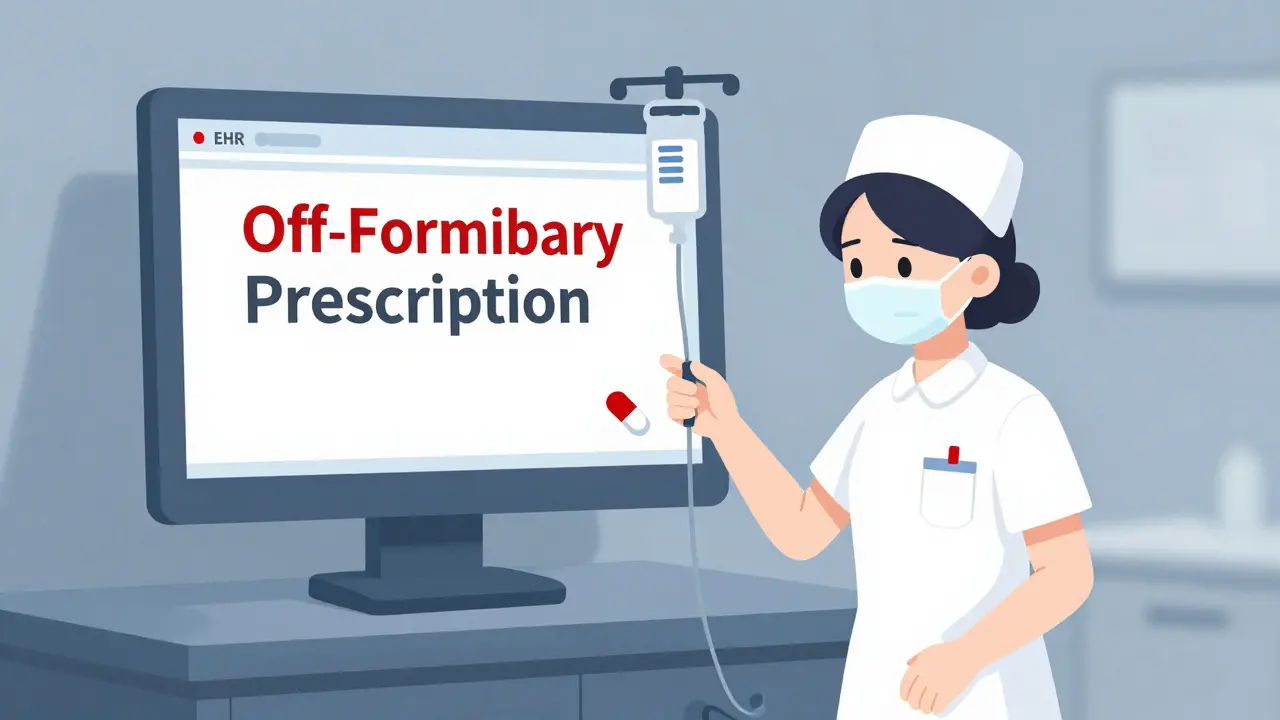
Electronic health records (EHRs) are supposed to help. But only 37% of hospitals have automated formulary alerts built into their systems. That means doctors often prescribe off-formulary drugs without realizing it. Studies show 15-20% non-adherence to formulary rules-costing hospitals millions in unnecessary spending.
What’s Changing in 2025 and Beyond
The landscape is shifting fast. Starting January 2025, the Consolidated Appropriations Act will require manufacturers to disclose hidden rebate structures. That transparency could force hospitals to stop chasing rebates and start chasing real value.
The FDA’s GDUFA III program is investing $4.3 million annually into complex generic development. By 2026, we should see more reliable injectables and inhalers enter the market.
And then there’s pharmacogenomics. Twenty-eight percent of academic hospitals now consider genetic data when selecting generics. For drugs like clopidogrel or warfarin, a patient’s DNA can predict whether they’ll respond. That’s not science fiction-it’s becoming standard practice.
Drug shortages are still climbing. The FDA tracked 298 active generic shortages in November 2023-the highest since 2011. Hospitals can’t rely on just one supplier anymore. They’re building flexible formularies with backup options, even if they cost more.
How Hospitals Get It Right
Successful formularies have three things:
- Strong clinical leadership: At least half the P&T committee must be pharmacists. They’re the ones who read the bioequivalence studies, spot the subtle differences, and ask the hard questions.
- Structured processes: Every new generic must be submitted with an AMCP dossier-clinical data, pharmacology, cost analysis. No exceptions.
- Real-time monitoring: Tracking outcomes after a switch. Are readmissions going up? Are labs changing? Are nurses complaining? If yes, the drug gets pulled.
It’s not about being cheap. It’s about being smart. The best hospitals don’t choose the lowest-cost generic. They choose the one that delivers the best outcome at the lowest total cost-over time, with no surprises.
Why don’t hospitals just pick the cheapest generic?
Because the cheapest drug isn’t always the cheapest overall. A generic with a low list price might come with hidden costs: inconsistent supply, higher rates of adverse events, extra lab monitoring, or increased nursing time. Hospitals look at total cost of ownership-not just the sticker price.
Are generic drugs as safe as brand-name drugs in hospitals?
For most drugs, yes. But for complex generics-like injectables, inhalers, or drugs with narrow therapeutic windows-small differences in formulation can matter. A generic inhaler might deliver a different particle size than the brand, affecting lung absorption. That’s why hospital P&T committees require more than FDA approval-they demand real-world clinical data.
How often do hospital formularies change?
Typically every 1-3 months. New drugs are reviewed within 90 days of FDA approval. Supply shortages, adverse event reports, and rebate changes can trigger emergency reviews. Formularies are living documents, not annual catalogs.
Do hospitals use the same formulary for inpatients and outpatients?
Usually not. Inpatient formularies are tighter, more controlled, and focused on acute care. Outpatient formularies (like those for clinic prescriptions) may allow more flexibility because patients manage their own meds. Some hospitals even maintain separate P&T committees for each setting.
What role do pharmacists play in formulary decisions?
Pharmacists lead the process. They review bioequivalence studies, analyze supply chain risks, model cost savings, and track clinical outcomes after a switch. At least half of every P&T committee must be clinical pharmacists. They’re the ones who catch the subtle differences that doctors might miss.

Ashlyn Ellison
February 8, 2026 AT 20:34Just read this and realized I’ve been taking generic metformin for 5 years. Never once thought about the manufacturing batch or inactive ingredients. Wild how much goes on behind the scenes.
Monica Warnick
February 9, 2026 AT 07:43Oh honey, you think THIS is wild? Wait till you hear about the time a hospital in Ohio switched to a generic insulin because it was 30 cents cheaper per vial… and then patients started going into DKA because the preservative changed the absorption rate. Nurses had to do fingersticks every 90 minutes. The cost savings? Gone. The lawsuits? Still pending.
Generics aren’t magic. They’re chemistry. And chemistry doesn’t care about your budget.
Also, the FDA doesn’t test for bioequivalence in critically ill patients. Only healthy volunteers. So yeah, your ‘equivalent’ drug might be a grenade in an ICU.
And don’t even get me started on 340B. Hospitals are gaming the system like it’s a tax loophole. They buy 500,000 units of a generic they’ll never use just to get the discount, then sell the surplus on the black market. It’s not healthcare-it’s Wall Street with a stethoscope.
And the P&T committees? Half of them are pharmacists who’ve never seen a patient. They read studies written by people who got paid by the manufacturer. It’s all theater.
Someone needs to audit the audits.
Ryan Vargas
February 10, 2026 AT 09:29Let’s interrogate the epistemology of pharmaceutical equivalence. The FDA’s bioequivalence paradigm is rooted in a positivist reductionism that assumes pharmacokinetic equivalence equals clinical equivalence-a fallacy of composition if ever there was one. The body is not a beaker. It is a dynamic, nonlinear, context-dependent system.
When a patient with renal impairment receives a generic phenytoin, the inactive excipients-silica, magnesium stearate, even the tablet coating-alter gastric pH, transit time, and mucosal permeability. These variables are ignored in the 80-125% AUC window used for approval.
Moreover, the concept of ‘cost-effectiveness’ in formulary decisions is a neoliberal construct that conflates monetary efficiency with therapeutic justice. The hospital’s mandate is not to minimize expenditure-it is to preserve life. Yet we’ve outsourced clinical judgment to spreadsheet algorithms.
And let us not forget: the 340B program was designed to protect the vulnerable. Now, it’s weaponized by nonprofit hospitals to subsidize executive bonuses. The irony is not subtle. It is surgical.
Until we decouple drug selection from financial incentives and return to a Hippocratic model-where the patient’s outcome is the sole metric-we are not healing. We are accounting.
Simon Critchley
February 12, 2026 AT 06:59Bro, the whole thing is a circus 🤡
Generics? More like ‘guess-tics.’
I worked in pharmacy for 8 years. Saw a guy on warfarin go from INR 2.1 to 6.8 after switching generics. He bled out in the hallway. No one knew why until we checked the label-different filler. Same active ingredient. Different dissolution profile.
And the rebates? 😂 The manufacturer gives the hospital $5 per unit to use their generic… then charges the insurer $12 to cover the ‘cost.’ The hospital pockets $7. The patient? Still pays $10 copay. Everyone wins except the patient.
Also, 340B? It’s a loophole so big you could fly a drone through it. Hospitals buy 10,000 units of a drug, give 200 to patients, sell the rest to a distributor. Profit: $1.2M. Ethics: zero.
And don’t get me started on the P&T committees. Half are ex-rep reps. They don’t care about outcomes. They care about who gave them the free trip to Cancún.
It’s not healthcare. It’s a rigged game. And we’re all just pawns with IVs.
Chelsea Cook
February 13, 2026 AT 04:55Y’all are overcomplicating this. If a generic works in a lab and the FDA says it’s good, why are we even having this conversation? It’s not like we’re asking for a miracle-just a pill that does the same thing as the expensive one.
Also, why are hospitals so obsessed with control? Can’t we just trust doctors? They went to med school! They know what they’re doing!
And honestly, if we’re so worried about safety, why don’t we just make all drugs brand-name? Then we’d have no problems. Except, you know, everyone would go bankrupt.
Maybe the real issue is that we don’t trust each other anymore. Patients don’t trust hospitals. Hospitals don’t trust manufacturers. Manufacturers don’t trust regulators.
It’s a trust crisis disguised as a formulary debate.
Also, I love how you all act like pharmacists are the only ones who know anything. What about nurses? They’re the ones giving the meds! They’re the ones seeing the reactions! Why aren’t they on the committee?
And what about the patient’s voice? Where’s their input? Nobody ever asks them. They just get the pill and shut up.
It’s time to include everyone. Not just the PhDs with spreadsheets.
Kathryn Lenn
February 15, 2026 AT 03:36Let’s be real: this whole system is a pyramid scheme disguised as clinical science.
The FDA approves generics based on data from companies that *manufacture* them. That’s like letting McDonald’s grade the nutritional value of a Big Mac.
And then hospitals? They don’t even test the drugs they’re giving. They just trust the paperwork. Meanwhile, nurses are seeing patients crash after a switch and they’re told, ‘It’s not the drug-it’s the patient.’
And the 340B program? Pure corruption. Hospitals use it to fund their golf memberships. I’ve seen it. I worked at one.
And the P&T committee? Half the members are reps from generic manufacturers. They show up with free lunch and a PowerPoint titled ‘Why Our Metformin Is Better Than the Rest.’ Spoiler: it’s not. It’s just cheaper.
And don’t get me started on the EHRs. They don’t alert doctors about formulary changes. Why? Because the EHR vendor gets paid by the drug companies to keep the brand-name options visible.
This isn’t about saving money. It’s about profit maximization under the guise of clinical excellence.
And you wonder why people hate healthcare?
Ritteka Goyal
February 16, 2026 AT 01:50Oh my god I just read this and I am so proud of my country!! India is the pharmacy of the world!! We make 40% of all generic drugs used in the US!! And you know what? We make them better!!
Indian manufacturers have the most advanced labs, the cleanest facilities, and the most skilled chemists!! You think the FDA is strict? Wait till you see the Indian drug regulator-they inspect every batch like it’s a bomb!
And the rebates? Hah! Indian companies don’t even do rebates! They just sell cheap and fair!!
Why do American hospitals still buy from Europe? Why not buy from India? We have 1000+ approved facilities! We have the best quality! We have the best prices!!
And you know what? We don’t have 340B loopholes because we don’t need them! We believe in medicine for all, not profit for some!!
Stop being so suspicious! Stop overthinking! Just use Indian generics!! They are safe, they are cheap, they are reliable!!
Also, I work in pharma in Mumbai. I have seen the machines. I have seen the labs. I have seen the workers. They are not poor. They are proud. They are professionals. They care. They love their jobs.
Why don’t you trust us? We are not the problem. We are the solution.
And if you don’t believe me? Come visit. I will show you. I will take you to the factory. I will feed you biryani. You will cry. You will change your mind.
Love from India ❤️
Frank Baumann
February 16, 2026 AT 09:09I’ve been on the front lines of this for 15 years and let me tell you-this isn’t a formulary debate. It’s a war.
One night in 2019, a 72-year-old woman on dialysis had a cardiac arrest. Her INR was 8.5. She almost died. Turned out, they switched her warfarin generic. Same label. Different manufacturer. Different coating. Slower dissolution. She was getting half the dose.
They blamed the patient. Said she ‘missed a dose.’
I looked at the chart. She took it every day. At the same time. With the same food.
It wasn’t her. It was the drug.
And when I raised it? The pharmacy director told me, ‘We saved $12,000 last quarter. Don’t ruin it.’
That’s the moment I stopped believing in ‘evidence-based medicine.’
It’s not evidence. It’s economics.
And now? Now every time a new generic hits the formulary, I check the manufacturer. I check the lot number. I check the expiration. I check the supplier. I check the rebate. I check the 340B eligibility. I check the nurse complaints. I check the lab trends.
I don’t trust anything anymore.
And you know what? I’m not paranoid.
I’m just awake.
Scott Conner
February 16, 2026 AT 20:40wait so if a generic has a different filler than the brand it can cause problems? like… literally just a sugar or starch? that seems wild
also why do hospitals care about supply chain so much? cant they just order more? like its not like they’re running out of toilet paper
and what even is 340b? sounds like a car model
and why do pharmacists get to decide? cant the doctors just pick what they want? they know the patients better
also i just looked up metformin and there are 15 different generics? like… why? who even keeps track of this
and why is this so complicated? it’s a pill. why does it need a PhD to approve it
Marie Fontaine
February 18, 2026 AT 05:26Y’all are overthinking this!! 😊
Just pick the generic that works, has good reviews, and doesn’t make nurses cry. That’s it. 🙌
Also, Indian generics are AMAZING!! I used them in my last hospital job and patients did GREAT!! 🇮🇳💖
And yes, 340B is weird… but if it helps safety-net hospitals serve more people? Let’s keep it!!
Pharmacists are the real MVPs. They’re the ones reading the tiny print while everyone else is scrolling TikTok. 👏
Also, stop blaming manufacturers. They’re trying. The system is broken, not them.
Let’s support the good ones. Call out the bad ones. And keep pushing for transparency!! 💪
Change is possible. We just gotta believe!! 🌟
Lyle Whyatt
February 20, 2026 AT 05:08Look, I’ve been in this game for over two decades-from rural Australia to Boston teaching hospitals-and here’s what I’ve learned: the formulary isn’t about drugs. It’s about power.
Who gets to decide what a patient receives? Who controls the narrative of ‘clinical necessity’? Who profits when a drug is pulled or added?
The P&T committee isn’t neutral. It’s a political body. Pharmacists, doctors, administrators-they all have agendas. The pharmacist wants to reduce workload. The doctor wants flexibility. The administrator wants to hit cost targets. The nurse wants consistency. The patient? They’re an afterthought.
And let’s be honest: most of these decisions are made in 15-minute meetings with PowerPoints that look like they were made in 2007.
What we need isn’t more data. It’s more humility.
What if we stopped trying to ‘optimize’ every drug and started listening to the people who actually administer them? The nurses. The pharmacists. The patients.
What if we stopped chasing rebates and started chasing trust?
What if we stopped pretending this is science… and admitted it’s a social contract?
I don’t have answers. But I know this: the status quo is killing people quietly.
Brett Pouser
February 20, 2026 AT 09:42Man, I just moved from the UK to the States and this whole formulary thing blew my mind.
Back home, we’ve got the NHS. One national formulary. Everyone gets the same drugs. No tiers. No rebates. No 340B nonsense.
Yeah, sometimes we wait a bit longer for new stuff. But we don’t have patients dying because a generic changed its coating.
And honestly? I’ve never seen a UK hospital pharmacist get a free trip to Cancún.
It’s not perfect. But it’s simple. And it works.
Here? It’s like a maze made of spreadsheets and corporate logos.
I get why hospitals do it. Budgets. Pressure. Liability.
But I also wonder… is this really healthcare?
Or is it just a very expensive game of financial chess?