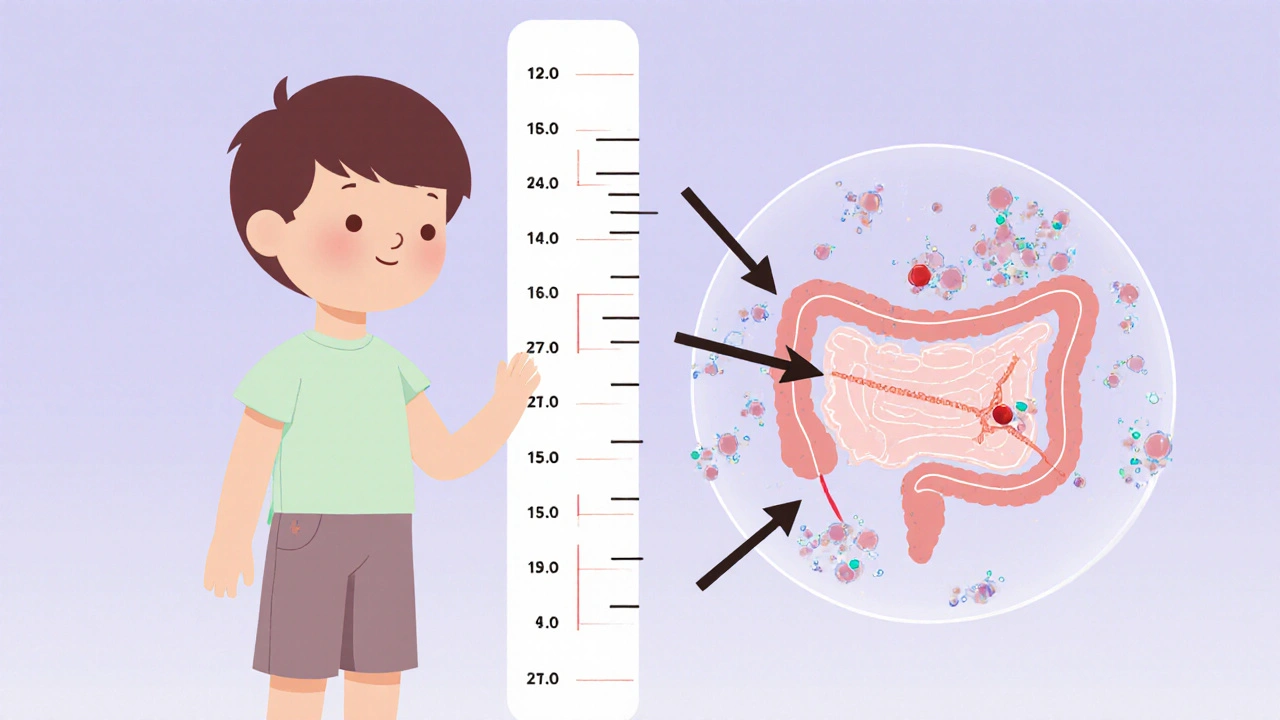
When a child isn’t growing like they should, parents often blame poor eating habits or late puberty. But sometimes, the real issue is hidden in plain sight: celiac disease. This autoimmune disorder doesn’t just cause stomach pain or diarrhea-it can stunt growth, weaken bones, and drain energy. The good news? If caught early, nearly every child can catch up and thrive-on a simple, strict gluten-free diet.
Why Growth Problems Are a Red Flag for Celiac Disease
Most kids with celiac disease don’t look sick. They might not have diarrhea or bloating. Instead, the first sign is often being shorter than their peers, falling behind on the growth chart, or not gaining weight as expected. In fact, up to 40% of children diagnosed with celiac disease are referred because of short stature alone. Their bodies aren’t absorbing nutrients properly because gluten is damaging the tiny finger-like projections in their small intestine called villi. These villi are responsible for absorbing calories, iron, calcium, vitamins-everything a growing child needs. When these villi flatten out, it’s like losing 60-90% of your nutrient-absorbing surface area. That’s why iron deficiency anemia shows up in 10-15% of kids at diagnosis, and why nearly half have low vitamin D. Bone age X-rays often reveal a delay of 1.5 to 2.5 years, meaning their skeleton is younger than their calendar age. That delay isn’t a problem-it’s actually a sign their body is still trying to grow. And when gluten is removed, catch-up growth usually follows. Studies show three patterns. Some kids snap back fast-gaining height quickly in the first year. Others grow slower than average but keep growing longer, eventually reaching normal adult height. A third group grows at a normal pace but takes longer to hit puberty, stretching out their growth window. The key? Diagnosis before age 5 gives a 98% chance of reaching target height. After age 10, that drops to 85%.How Celiac Disease Is Tested-Now and How It’s Changed
Testing for celiac disease in children isn’t what it used to be. Ten years ago, every child with suspected celiac got an endoscopy and biopsy. Now, under updated guidelines from ESPGHAN (2020), many don’t need one. The first step is a simple blood test: tissue transglutaminase IgA (tTG-IgA). It’s 98% accurate at detecting active celiac disease. But there’s a catch: some kids have IgA deficiency, which makes this test falsely negative. So doctors always check total IgA levels too. If tTG-IgA is more than 10 times the upper limit of normal, and the child has symptoms, and they carry the HLA-DQ2 or DQ8 genes (which 95% of celiac patients do), then diagnosis can be made without a biopsy. That’s a big deal. It means fewer needles, no sedation, and less stress for kids. Biopsies are still needed when blood tests are borderline, or if the child has no clear symptoms. The biopsy shows Marsh 3 damage-complete or near-total flattening of the villi-which confirms the diagnosis. Doctors now routinely screen kids with type 1 diabetes, Down syndrome, or a close relative with celiac. About 5-10% of children with a family history develop it by age 10. That’s why testing siblings is often recommended, even if they show no symptoms.What a Gluten-Free Diet Really Means-Beyond Bread
Going gluten-free sounds simple: no wheat, barley, rye. But it’s not just about avoiding pasta and pizza. Gluten hides in soy sauce, malt flavoring, processed meats, salad dressings, even some medications and vitamins. Cross-contamination is the biggest trap. A toaster used for regular bread, a shared cutting board, or even flour dust in the air can trigger a reaction in a sensitive child. The international standard allows up to 20 parts per million (ppm) of gluten in labeled gluten-free foods. That’s tiny-but enough to damage the gut if eaten daily. For a child, that means every meal, every snack, every treat must be checked. Only 15-20% of regular grocery items are naturally gluten-free. The rest require careful label reading. Gluten-free products cost 156-242% more than regular ones. That’s a heavy burden for families. But it’s not just about money. It’s about social life. Teens report skipping school lunches, avoiding birthday parties, or sneaking gluten because they feel left out. One 14-year-old said, “I got sick after eating a cookie at a friend’s house. I didn’t want to be the weird kid who couldn’t eat anything.”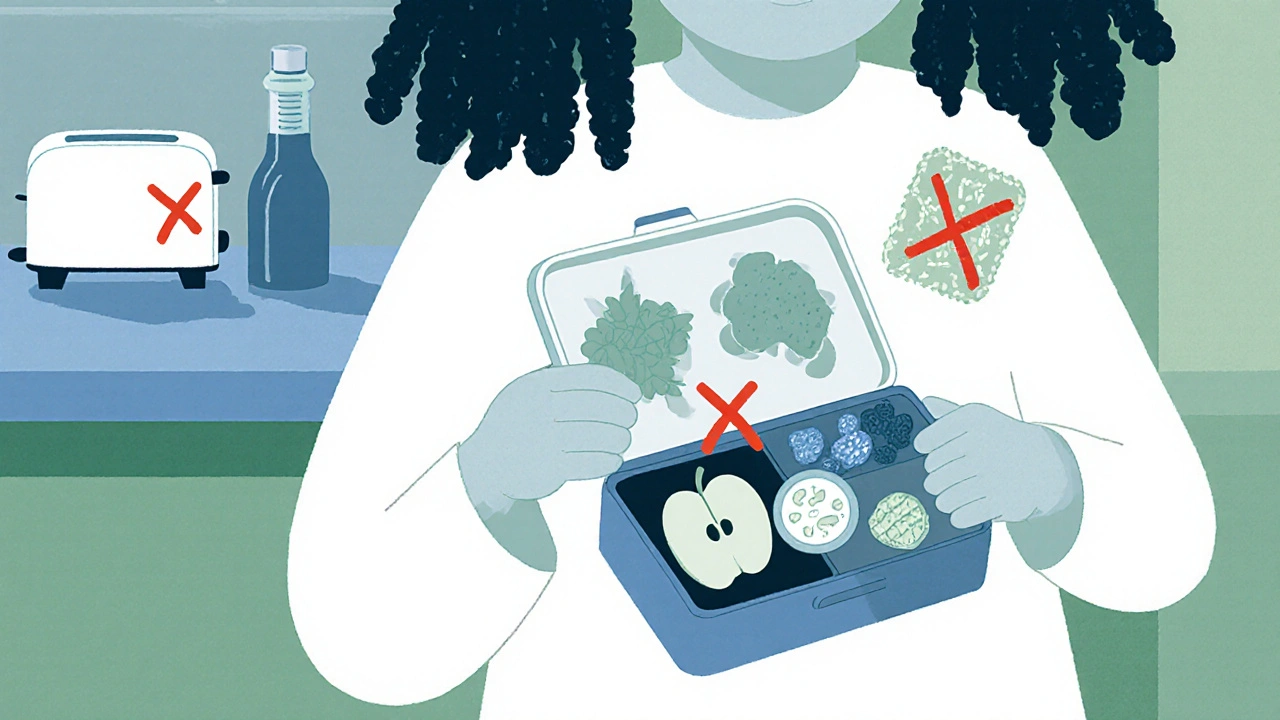
Tracking Progress: How You Know the Diet Is Working
The diet isn’t a one-time fix-it’s a lifelong commitment. And progress isn’t always obvious. Weight usually improves within 6 months. Height takes longer-often 18 to 24 months. The best sign? Rising tTG-IgA levels dropping back to normal. That’s the gold standard for adherence. But here’s the hard truth: 20-30% of kids still show positive antibodies even when parents think they’re doing everything right. Why? Cross-contamination. Hidden gluten. Or sometimes, a misdiagnosis. Doctors track growth closely. Infants should gain 15-30 grams per day after starting the diet. Older kids should gain 2-4 cm per year more than expected. If height doesn’t improve after 12 months, doctors check for other issues-like growth hormone deficiency or thyroid problems. About 5-10% of kids don’t catch up fully, even with perfect diet adherence. That’s not failure-it’s a signal to dig deeper. Nutritional checks are just as important. Iron, vitamin D, folate, and B12 are routinely tested every 3-6 months. Many kids need supplements for a year or more. A ferritin level below 15 ng/mL means iron stores are dangerously low. Vitamin D below 20 ng/mL needs aggressive correction. Bone density scans may be done if delays are severe.How Families Succeed-Education, Support, and Systems
Parents don’t come into this knowing how to read food labels or clean a kitchen to avoid gluten. It takes time. Children’s Hospital of Philadelphia found most families need 3-5 nutrition visits before they feel confident. It takes 4-6 months just to learn where gluten hides. School is the biggest battleground. A 2022 study found 58% of kids with celiac get exposed at school-through shared utensils, classroom snacks, or cafeteria mistakes. That’s why a 504 plan is critical. It legally requires the school to provide safe meals, train staff, and create a gluten-free zone for food prep. Community support makes a huge difference. Families connected to local celiac groups have 25-30% better adherence. They swap recipes, share safe brands, and vent about the stress. One mother said, “Finding a mom who gets it-someone who knows what ‘gluten-free’ really means-saved us.”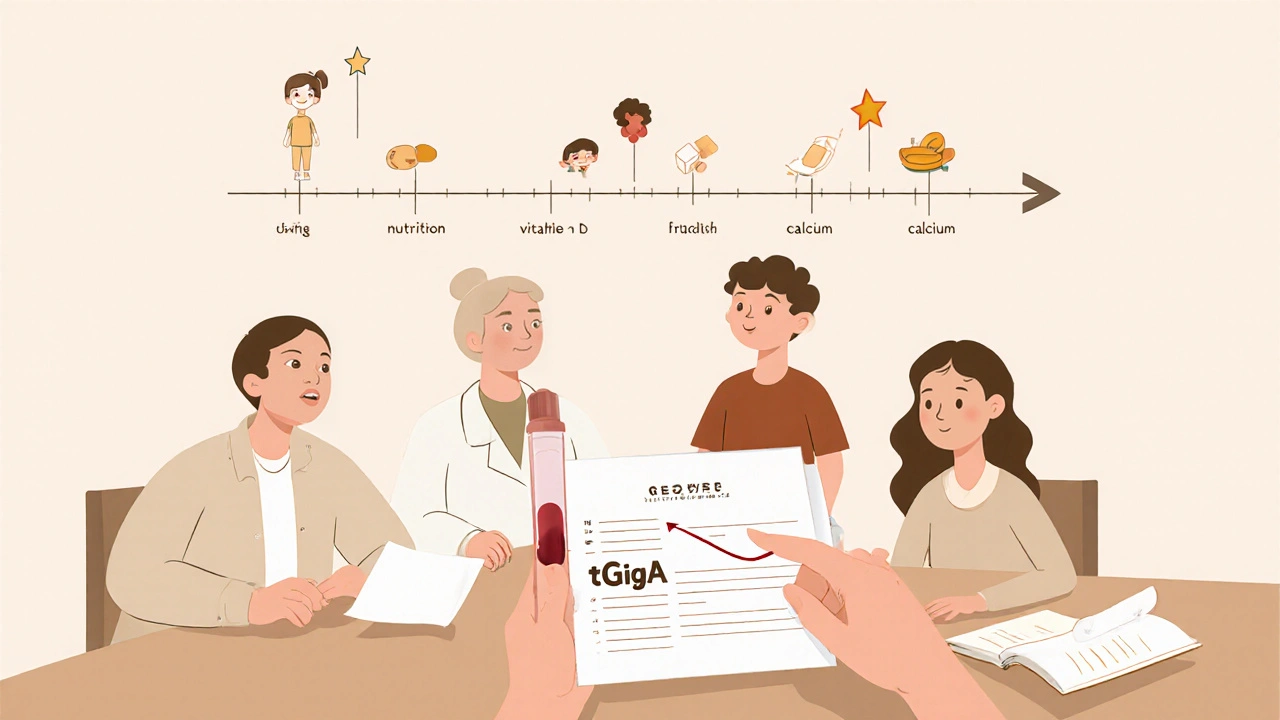
What’s Next? New Treatments and Hope
Right now, the only treatment is a lifelong gluten-free diet. But research is moving fast. Drugs like larazotide acetate are in Phase 3 trials. It doesn’t cure celiac-it just blocks gluten from leaking into the gut, reducing symptoms if someone accidentally eats it. It’s not a replacement for the diet, but it could be a safety net. Immunotherapy trials, like Nexvax2, were paused after failing to work in early tests. But science hasn’t given up. The goal is to one day allow people with celiac to eat gluten without harm. For now, the message is clear: early diagnosis + strict diet = normal growth, normal life. Kids diagnosed before age 5 have the same life expectancy as anyone else. They go to college, play sports, fall in love. They just have to read labels.What If Your Child Doesn’t Improve?
If your child is on a strict gluten-free diet for 12 months and still isn’t gaining height or has ongoing symptoms, ask for a full workup. Check for:- Continued gluten exposure (even tiny amounts)
- Other autoimmune conditions (like thyroid disease)
- Growth hormone deficiency
- Small intestinal bacterial overgrowth (SIBO)
- Refractory celiac disease (rare, but possible)
Can a child outgrow celiac disease?
No. Celiac disease is a lifelong autoimmune condition. You cannot outgrow it. Even if symptoms disappear, the immune system still reacts to gluten. Eating gluten-even occasionally-can cause ongoing intestinal damage and increase the risk of complications like osteoporosis or lymphoma later in life.
Is a gluten-free diet healthy for a child without celiac disease?
Not necessarily. Gluten-free products are often lower in fiber, iron, and B vitamins, and higher in sugar and fat. Unless a child has celiac disease, non-celiac gluten sensitivity, or a wheat allergy, there’s no proven health benefit. Cutting out whole grains without medical reason can lead to nutritional gaps. Don’t start a gluten-free diet for a child without testing first-it can hide celiac disease and make diagnosis impossible.
How do I know if my child is getting enough nutrients on a gluten-free diet?
Regular blood tests are key. Check iron (ferritin), vitamin D, folate, and B12 every 6 months for the first 2 years after diagnosis. Many children need supplements, especially in the first year. Work with a registered dietitian who specializes in celiac disease-they can help you build balanced meals with naturally gluten-free foods like fruits, vegetables, meats, eggs, dairy, rice, quinoa, and beans.
What should I do if my child accidentally eats gluten?
Don’t panic. One exposure won’t undo all progress, but it can cause symptoms for days or weeks. Watch for abdominal pain, fatigue, or mood changes. Resume the strict gluten-free diet immediately. If symptoms last more than a week or are severe, contact your pediatric gastroenterologist. Keep a log of accidental exposures-it helps identify patterns and prevent future mistakes.
Are there gluten-free snacks that are actually good for kids?
Yes. Focus on whole foods: apple slices with peanut butter, hard-boiled eggs, plain yogurt with berries, cheese sticks, rice cakes with avocado, hummus with carrot sticks. Many packaged gluten-free snacks are highly processed and full of sugar. Read labels. Look for products with simple ingredients-no hidden wheat, barley, or malt. Brands like Enjoy Life and Bob’s Red Mill offer reliable, kid-friendly options.
Can my child eat oats on a gluten-free diet?
Pure, uncontaminated oats are safe for most children with celiac disease. But most oats are processed in facilities that also handle wheat, so they’re often contaminated. Only use oats labeled “certified gluten-free.” Introduce them slowly after the diet is well-established, and monitor for symptoms. About 5-10% of people still react to even pure oats-so always check with your doctor first.


Peter Lubem Ause
November 30, 2025 AT 00:43Early diagnosis is everything. My nephew was diagnosed at 4 after falling off the growth chart-he was tiny but otherwise seemed fine. Within 6 months of going gluten-free, he started shooting up. Now he’s taller than most kids his age. The blood test is simple, cheap, and non-invasive. Why wait until they’re 10 and lose that 98% catch-up chance? Get it checked if there’s any doubt.
Parents, don’t assume it’s just ‘picky eating.’ It’s not. It’s your child’s body literally starving because their gut is being eaten alive by gluten.
linda wood
December 1, 2025 AT 13:36So let me get this straight-you’re telling me a kid can be ‘normal’ looking, eating ‘fine,’ and still be malnourished because their intestines are shredded? And the solution is… more expensive food and reading tiny print on labels for the rest of their life?
Wow. Just wow. Glad I’m not a parent.
LINDA PUSPITASARI
December 2, 2025 AT 07:45YES YES YES 😭 I’ve been here. My daughter was 7 when diagnosed-no stomach issues, just super tired and short. We went gluten-free and she cried the first week because she missed pizza. Now? She’s got her own gluten-free lunchbox, brings snacks to birthday parties, and even helped me make GF pancakes last weekend 🥞💖
Pro tip: Certified GF oats are a game changer. And always check vitamins-they’re sneaky!
Also-get a 504 plan. My school didn’t get it until I showed up with a doctor’s letter and a 10-page binder. Then they were like ‘ohhhhh’ 😅
gerardo beaudoin
December 4, 2025 AT 03:11My cousin’s kid got diagnosed after a routine blood test for anemia. No symptoms. Just low iron. Turned out her villi were basically flat. She’s 12 now, plays soccer, eats gluten-free pizza like it’s nothing. The diet is a pain, sure-but it’s not a death sentence. It’s just a different way of living.
And yeah, the cost sucks. But I’d rather pay extra for food than have my kid end up with osteoporosis at 30.
Sullivan Lauer
December 5, 2025 AT 18:20Let me tell you something-this isn’t just about growth. It’s about survival. I watched my niece go from a bright, chatty 5-year-old to a quiet, tired shell because no one connected the dots. She wasn’t ‘just slow’-her body was shutting down, one nutrient at a time. When we finally cut gluten? She came back to life. Like someone flipped a switch.
She started laughing again. Started asking questions. Started climbing trees. That’s not ‘catch-up growth’-that’s a second chance at childhood.
And if you’re reading this and you’re a parent who thinks ‘maybe it’s just genetics’-you’re not just being cautious. You’re risking your child’s future. Don’t wait for them to scream. They won’t. They just get smaller.
Joy Aniekwe
December 5, 2025 AT 18:38Oh wow. So now we’re blaming gluten for everything? Next you’ll say my kid’s bad grades are because of trace wheat in the crayons.
And yes, I know this is ‘science’-but it’s also a billion-dollar industry selling overpriced rice cakes. Tell me again why we’re not just giving kids multivitamins and calling it a day?
Matthew Higgins
December 6, 2025 AT 01:05My brother’s kid got diagnosed at 6. They used to buy all the cheap gluten-free junk food-then the kid kept getting stomachaches. Turned out the ‘gluten-free’ cookies had barley malt syrup. No one checks the ingredients. Just the label.
Now they cook everything from scratch. Kids eat quinoa bowls, roasted veggies, grilled chicken. They’re happier. Less sugar. More energy. Honestly? It’s better than the processed crap most kids eat anyway.
It’s not about being ‘special.’ It’s about being healthy.
Mary Kate Powers
December 6, 2025 AT 07:30One thing no one talks about: the emotional toll on siblings. My daughter was 8 when her brother got diagnosed. She started hiding snacks in her room because she felt guilty eating ‘normal’ food. Took months before she felt okay about it.
Parents-talk to your other kids. Let them know it’s not a punishment. It’s just how your family eats now. And let them help pick out new snacks. They’ll feel included, not left out.
Sara Shumaker
December 7, 2025 AT 07:49There’s a deeper layer here we rarely acknowledge: celiac disease forces families to become experts overnight. You’re not just managing a diet-you’re navigating bureaucracy, stigma, and isolation. Schools don’t get it. Relatives don’t get it. Even doctors sometimes don’t get it.
But here’s what I’ve learned: the more you learn, the more power you gain. Not just over food labels-but over your child’s future. Knowledge becomes armor.
And yes, it’s exhausting. But you’re not alone. There are communities. There are people who’ve walked this path. You just have to reach out.
Andrew Keh
December 7, 2025 AT 19:02It’s important to remember that celiac disease is not a fad. It’s a real medical condition with real consequences. The fact that so many children go undiagnosed for years is a failure of our healthcare system, not a lack of parental awareness.
Simple blood tests should be part of routine checkups for any child with unexplained growth delays. We don’t wait for heart disease to show symptoms before screening. Why do it for celiac?
Scott Collard
December 8, 2025 AT 12:20Gluten-free is a scam. The real issue is processed food. Stop buying the overpriced substitutes. Just eat meat, veggies, eggs. Done.
Also, your kid doesn’t need a 504 plan. Teach them to say no.
Sohini Majumder
December 8, 2025 AT 17:31OMG I’m crying rn 😭😭😭 my cousin’s kid had celiac and she was like 9 and they didn’t know until she collapsed at school and they thought it was an eating disorder?? like… what even is this world??
gluten is the devil and i hate it and i’m so mad now
tushar makwana
December 8, 2025 AT 19:21In India, we don’t have much awareness. Many think it’s just ‘stomach problem’ or ‘allergy.’ My neighbor’s daughter was diagnosed after months of being called ‘skinny girl.’ Now she’s thriving on rice, dal, and lentils-no wheat at all. Simple foods, real healing.
Doctors here don’t test unless you beg. But if you know the signs… you can save a child.
Don’t wait for a hospital. Start with a blood test.
Richard Thomas
December 10, 2025 AT 16:46While the clinical utility of early diagnosis and strict dietary adherence is well-documented in peer-reviewed literature, one must not overlook the socioeconomic implications of lifelong gluten avoidance, particularly in populations with limited access to fortified alternatives or nutritional counseling. The disparity in health outcomes between affluent and under-resourced families is not merely logistical-it is ethically significant.
Furthermore, the normalization of gluten-free diets in non-clinical contexts risks pathologizing normal dietary variation, potentially leading to iatrogenic harm through nutritional deficiencies induced by unwarranted dietary restriction.
Latika Gupta
December 12, 2025 AT 01:23My daughter’s teacher said she was ‘just shy’… until she started vomiting after every school snack. I didn’t know it was gluten until I read this article. Now I send her lunch every day. I’m so angry I didn’t know sooner.